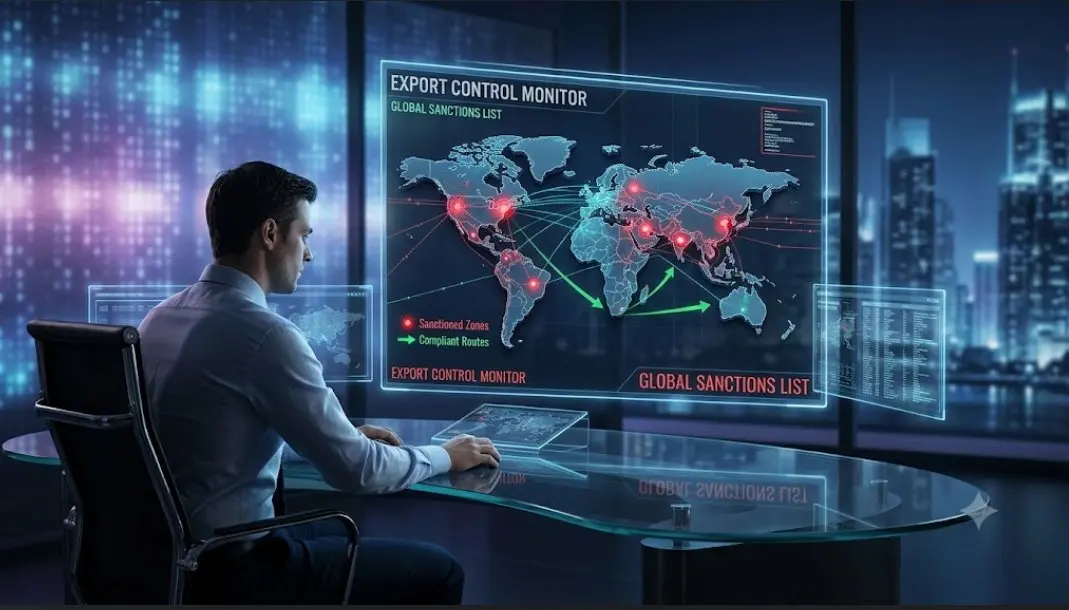

Chinese exporters and technology companies increasingly face entity-list designations, SDN listings, and multi-jurisdiction export control reviews. This article explains the compliance architecture that matters for companies shipping dual-use or controlled items, based on the export control and trade sanctions practice of Helen Yao at Beijing Yingke (Zhuhai) Law Firm.
Why Export Control and Sanctions Compliance Now
The Legal Rule
Reviewed by Helen Yao , Beijing Yingke (Zhuhai) Law Firm · Primary sources Chinese exporters and technology companies increasingly face entity-list designations, SDN listings, and multi-jurisdiction export control reviews.
The Business Impact
Verify classification, customs value, origin, licence status and the document chain for the actual goods. A mistake in any one of those inputs can delay clearance or change the duty, preference or penalty exposure. Apply that to the facts of Export Control and Trade Sanctions Compliance for Chinese Companies.
China's Export Control Law (), effective 1 December 2020, established a unified legal framework for controlling the export of dual-use items, military items, nuclear items and related technologies and services. The Anti-Foreign Sanctions Law (), effective 10 June 2021, authorises China to take countermeasures against foreign entities that participate in or assist in discriminatory restrictions against China.
Article 2 of the Export Control Law applies to dual-use items, military goods, nuclear and other items, technologies and services whose export is restricted for reasons of national security and the maintenance of international peace and obligations under international treaties.
Companies doing business with the United States, the European Union and other jurisdictions must also contend with the US Export Administration Regulations (EAR), the International Traffic in Arms Regulations (ITAR), and the EU's trade sanctions framework. Compliance is no longer a footnote to commercial contracts; it is a board-level risk.
Blacklist Removal and Crisis Response
When a company is placed on the US Entity List, the Specially Designated Nationals (SDN) List, or the Unverified List, the immediate risk is supply chain disruption: suppliers may stop shipping, banks may freeze payments, and counterparties may terminate contracts. Crisis response must begin within days.
- Internal investigation to establish the factual basis for the listing
- Legal remedy analysis, including delisting petitions under EAR Part 744 and OFAC administrative procedures
- Communication with US and EU authorities, including engagement letters, narrative submissions and evidence packages
- Interim supply chain measures to limit exposure while the delisting process runs
Building an Export Compliance Program (ECP)
An Internal Compliance Program (ECP) aligned with multi-jurisdiction expectations includes control processes, review forms, contract protection clauses (sanction and export control clauses), regular compliance audits and employee training. For Chinese companies, the ECP must simultaneously satisfy PRC export control requirements and the expectations of overseas regulators such as the US Bureau of Industry and Security (BIS).

- PROGRAM MAP
- Jurisdiction matrix
- US, EU, China, destination states
- Screening + ownership look-through
ECCN Classification and Licence Applications
Correctly identifying whether a product, technology, software or component is controlled is the foundation of any export compliance effort. ECCN classification under the EAR, controlled attribute assessment under the PRC Export Control Law, and licence applications to China's Ministry of Commerce, BIS or EU authorities all depend on accurate item characterisation. Licence conditions must be tracked, and record retention periods respected.
Supply Chain Restructuring and De-risking
High-risk countries, restricted entities and sensitive transaction links should be identified and managed proactively. A de-risking trade and investment structure, supported by rigorous customer and supplier due diligence (KYC/KYP), reduces the risk of supply chain disruption and large penalties.
How Helen Yao Can Help
Helen Yao is an export control and trade sanctions compliance lawyer at Beijing Yingke (Zhuhai) Law Firm. She graduated from Jilin University and has more than 20 years of professional experience, including roles with listed companies and foreign-invested enterprises. She serves as Vice Secretary-General of the Zhuhai Enterprise Compliance Promotion Association and as a commercial mediator at the Hengqin International Commercial Mediation Center.
Her practice covers blacklist removal and crisis response, multi-jurisdiction ECP building and assessment, controlled item classification and licence applications, and supply chain restructuring and transaction design for state-owned enterprises, cross-border listed companies and high-growth private enterprises.
Understanding China's Export Control Law Framework
China's Export Control Law, in force since 1 December 2020, governs dual-use items, military items, nuclear items and other goods, technologies and services whose export is restricted for national security reasons or to fulfil international obligations. The law establishes a licensing system: exports of controlled items generally require an export licence, and exporters must apply to the competent authority, typically the Ministry of Commerce for dual-use items, before shipping. The accompanying dual-use item control lists and the two-level administrative catalogue system determine whether an item is controlled and what licence type applies.
In practice, exporters must check three dimensions for every transaction: whether the item is on a control list or falls under catch-all provisions; who the end user and end use are, including any restricted or designated entities; and whether the destination raises screening obligations. A failure at any one of these layers can result in refusal of export, administrative penalties, or referral to criminal investigation.
The Anti-Foreign Sanctions Law and Countermeasures
The Anti-Foreign Sanctions Law, effective 10 June 2021, allows China to impose countermeasures against individuals and entities that directly or indirectly participate in the formulation or implementation of discriminatory restrictive measures against China. Countermeasures can include prohibiting transactions and cooperation with the designated person or entity, and freezing their property within China. For foreign companies operating in China, the practical consequence is a growing compliance matrix: a company may simultaneously be subject to US sanctions or export controls, EU restrictive measures, and Chinese countermeasures that restrict dealings with designated foreign parties. Counsel should map these overlapping obligations before they collide in a single transaction.
Entity List, SDN List and Unverified List: Practical Differences
The US Entity List, maintained by BIS under the EAR, imposes a licence requirement on exports, re-exports and in-country transfers of items subject to the EAR to listed parties, with a policy of denial for many entries. The Specially Designated Nationals and Blocked Persons (SDN) List, maintained by OFAC, blocks property and interests in property of listed parties and prohibits virtually all transactions with them by US persons. The Unverified List identifies foreign parties whose bona fides BIS could not verify through an end-use check; it does not impose a prohibition, but shipments to unverified parties often require enhanced due diligence and, in some cases, a filing under the EAR.
Each list has a different legal basis, a different administrative remedy and a different timeline for removal. A delisting strategy therefore cannot be a template: it must be built on the specific reasons for the listing, the company's ownership and end-user record, and the evidence that can be produced to the regulator. Delisting petitions under EAR Part 744, administrative reconsideration under Chinese law where applicable, and coordinated engagement with overseas counsel and the listed company's customers are all part of a complete response.

- Map regimes that touch the business
- US/EU/CN/destination
- Build unified screening
- ['Ownership included']
- Classify products/tech
Designing a Multi-Jurisdiction Export Compliance Program
A robust ECP addresses organisation, screening, training and record keeping. At minimum, a Chinese exporter with US or EU exposure should maintain a controlled-item matrix by product line; a customer and end-user screening process covering sanctions lists, entity lists and restricted-party lists; end-use questionnaires for sensitive customers; written export control clauses in contracts; and an escalation path for red flags. The programme must be updated as control lists change, which in the current environment can happen multiple times a year. Regular compliance audits, independent testing of screening results, and board-level reporting turn a paper policy into an operational control.
Supply Chain De-Risking and Transaction Design
De-risking does not mean abandoning profitable markets; it means structuring transactions so that controlled items, restricted parties and high-risk destinations are identified before commitments are made. Practical measures include segmenting product lines by control status, limiting resale rights for controlled goods, screening distributors and freight forwarders as well as direct customers, and including audit and cooperation clauses that allow the exporter to verify end use after delivery. Where a supply chain passes through multiple jurisdictions, origin and re-export rules must be considered at the design stage, not after a shipment is stopped.
Attribution
Reviewed by Helen Yao, Beijing Yingke (Zhuhai) Law Firm. Advises Chinese companies on export-control and trade-sanctions compliance programmes (ECP), licence applications, entity-list themes and supply-chain de-risking across PRC, US and EU regimes. View directory profile →
Review tier: Reviewed by — accuracy review of drafts for orientation only. Content remains general information — not legal advice for a specific matter, and no attorney–client relationship is created by reading these pages.
Last reviewed: August 2026 · Related: Primary sources · Outbound decision hub.
Discussion
Share experience or questions about this topic. This is a public discussion — not legal advice. Do not post confidential case details.
Have a question after reading? Leave it here, or Ask a Lawyer for a free initial intake.
Comments are moderated. China Legal Portal is a directory and information resource; no attorney–client relationship is formed by posting here.