

Direct answer
The Legal Rule
It does not classify products, apply the Foreign Direct Product Rule, or decide whether a license is required.
The Business Impact
Use “Why U.S. Export Controls Can Apply to Chinese Companies Outside the United States” to set the compliance steps before the goods move, not after they reach the border. Confirm the declarant, permits, valuation basis and supporting evidence early enough to fix gaps without disrupting delivery.
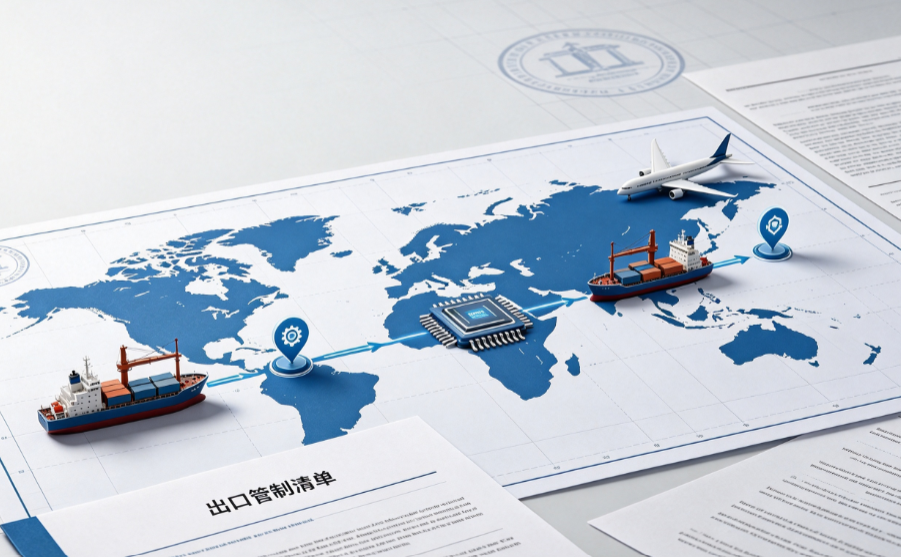
U.S. export controls can affect a Chinese company that has no U.S. warehouse, no U.S. export declaration and no plan to sell into the United States. The trigger is often a U.S. item, U.S. software, a restricted buyer, a third-country hub, or a foreign-made product that still has a U.S. technology nexus — not a container leaving Long Beach.
If any of those facts appear, stop treating “we are a China exporter” as a complete answer. Open the EAR analysis desk for jurisdiction, classification and licensing method. Open the screening desk if the question is how to search parties. Open the US tracker if the question is what changed this month.

- 1. U.S. parts
- Buying a U.S.-origin
- component or tool
- for a China factory
- Reexport / transfer risk
Five situations that surprise boards
1. You buy U.S.-origin components or tools
A motor, sensor, spare part or production tool that is U.S.-origin can remain subject to U.S. reexport rules after it sits in a Shenzhen warehouse. “We imported it into China already” does not close the file.
2. Engineers use U.S. software or design technology
Remote access to U.S. EDA tools, firmware source, or controlled technical data can be a release even when no box is shipped. The commercial team often never sees the login.
3. The customer (or their customer) is restricted
An ordinary-looking sale can still raise a license-policy problem if the buyer, consignee or downstream user is on a relevant U.S. list. A clean name search is not the analysis — see the screening desk — but the effect of a listing is an EAR question on the pillar guide.
4. A third-country subsidiary reexports
Singapore, Hong Kong, Vietnam or Mexico hubs do not automatically wash U.S. goods or U.S. technical data. A reexport from a friendly third country can still be an EAR-controlled act.
5. The product is made outside the United States
Foreign manufacture is not a safe harbour. U.S. content can matter (de minimis). Specified U.S. technology used in a foreign plant can matter (Foreign Direct Product). Those tests are on the EAR desk, not in this article.
What this article will not do
- It will not walk ECCN versus EAR99 or publish a Country Chart.
- It will not run a de minimis percentage or an FDP footnote.
- It will not teach restricted-party screening or Entity List removal.
- It will not rank for the full “US export controls for Chinese companies” query — that URL is the EAR compliance guide.
What to do next
- Write down which of the five situations might be true — even if the facts are incomplete.
- Do not accept a marketing origin story (“assembled in China”) as the legal answer.
- Open U.S. Export Controls for Chinese Companies: EAR, ECCN, Entity List and Licensing Guide and complete the jurisdiction → classification → license path.
- If a party name is the issue, use the screening desk.
- If the question is “what did BIS change this week?”, use the US tracker.
FAQs
We only sell inside China. Can U.S. rules still matter?
Yes, if the item, software or technology is still subject to the EAR, or if an in-country transfer to a restricted party is in scope. See situation 1, 3 and 5, then the EAR desk.
Does incorporating in Singapore avoid U.S. export controls?
No. A third-country company can still reexport U.S.-origin items or U.S. technology. Incorporation is not a jurisdiction test.
Is this the same as Section 301 tariffs or UFLPA?
No. Those are U.S. import topics. This insight is about controls on exports, reexports and technology releases. Do not mix the files.
Open the EAR analysis guide Request counsel
Orientation only — not legal advice and not a classification or license determination. Last reviewed: 16 August 2026
Attribution
Reviewed by Kathrine Boer, Boer & Hendricks, LLP (Houston). Advises multinationals and Chinese outbound investors on OFAC sanctions, EAR/ITAR themes, ECCN classification, licensing and export compliance programme design. View directory profile →
Review tier: Reviewed by — accuracy review of drafts for orientation only. Content remains general information — not legal advice for a specific matter, and no attorney–client relationship is created by reading these pages.
Last reviewed: August 2026 · Related: Primary sources · EAR analysis desk.
Discussion
Share experience or questions about this topic. This is a public discussion — not legal advice. Do not post confidential case details.
Have a question after reading? Leave it here, or Ask a Lawyer for a free initial intake.
Comments are moderated. China Legal Portal is a directory and information resource; no attorney–client relationship is formed by posting here.