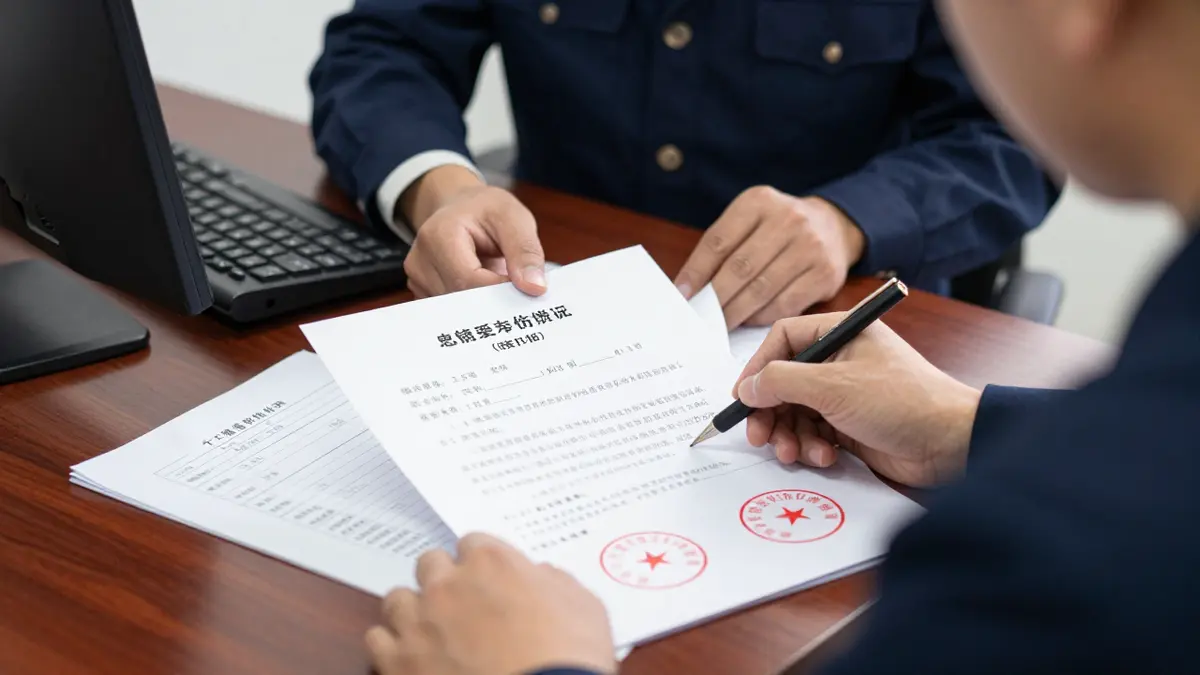

Workers compensation claims in China follow a defined statutory procedure that is essential for both employers and employees to understand. From the initial reporting of a workplace injury to the determination of disability grade and benefit calculation, each step involves specific legal requirements and time limits that can significantly affect the outcome of a claim.
Work Injury Determination Process
The Legal Rule
The employer must file an application with the local human resources and social security bureau within 30 days of the workplace injury or the diagnosis of an occupational disease.
The Business Impact
Align the written contract, payroll records, policies and actual workplace practice. Informal arrangements that contradict the documents often become the employer’s weakest point when a labour dispute starts. Apply that to the facts of Workers Compensation Claims: A Practical Guide.
The first step in any workers compensation claim is obtaining a Work Injury Determination Certificate. The employer must file an application with the local human resources and social security bureau within 30 days of the workplace injury or the diagnosis of an occupational disease. If the employer fails to file, the employee or their family members may file the application themselves within one year of the injury. The bureau must issue its decision within 60 days, extendable to 90 days for complex cases. The determination considers whether the injury arose out of and in the course of employment, and the law presumes that injuries occurring during working hours and at the workplace are work-related.
Qualifying injuries include workplace accidents, work-related travel injuries, workplace violence, emergency rescues, and occupational diseases listed in the national catalog. Injuries caused by intentional misconduct, intoxication, or self-inflicted harm are excluded from coverage. The employee should ensure the injury is properly documented with medical records and witness statements at the time it occurs. Photographs of the accident scene, the employee's injuries, and any safety equipment or conditions relevant to the accident should be preserved as evidence. A prompt and thorough accident investigation by the employer can help establish the facts while they are still fresh and witnesses are available.
Disability Grade Assessment and Benefits
Once work injury is confirmed, the employee undergoes a disability grade assessment under the GB/T 16180 standard, which classifies injuries into ten grades with grade one being the most severe. For grade one to four disabilities, the employer cannot terminate the employment relationship, and the employee receives a lump-sum disability payment of 21 to 27 months of salary plus a monthly disability allowance from the work injury insurance fund. For grades five and six, the employee may remain employed in a suitable position or terminate and receive a lump-sum payment. For grades seven through ten, the employee receives a smaller lump-sum payment and typically returns to work after recovery.

- Work-related injury recognition, social-insurance benefits, and employer top-up / civil claim.
- Work-Injury Compensation Claims.
- FAILURE MODES
- Work-related injury determination
The lump-sum medical subsidy and employment subsidy for terminated employees ranges from 3 to 30 months of salary depending on the grade. All employers must participate in the work injury insurance system, with premiums paid entirely by the employer at rates of 0.2 to 1.9 percent of total payroll depending on industry risk classification. Employers who fail to enroll are personally liable for all compensation costs that would otherwise be covered by the insurance fund. For serious injuries involving permanent disability or long-term care needs, these costs can run into hundreds of thousands of yuan, making work injury insurance compliance a critical risk management priority for employers.
Medical Treatment and Rehabilitation
Employees with work-related injuries are entitled to medical treatment at designated hospitals, with costs covered by the work injury insurance fund. The stop-work period for medical treatment allows the employee to take paid leave while recovering, during which they receive their original salary and benefits from the employer. The stop-work period is typically up to 12 months, extendable by another 12 months with medical certification. During this period, the employee cannot be terminated and is not required to use annual leave. After the stop-work period, if the employee remains unable to work, they may be assessed for continuing disability benefits.
Rehabilitation services, including physical and occupational therapy, are also covered when medically necessary and provided at designated rehabilitation facilities. Employers who fail to enroll in the work injury insurance system face personal liability for all costs that would otherwise be covered by the fund, including medical treatment, rehabilitation, disability payments, and any other benefits the employee would have been entitled to receive. This personal liability extends to the full duration of the employee's disability, which can be a lifetime obligation in cases of permanent total disability. Employers should verify that their work injury insurance contributions are current and that all employees are properly registered in the system.
Dispute Resolution and Practical Advice
Disputes over work injury determination, disability grading, or benefit amounts may be resolved through administrative review or litigation. An employee who disagrees with the determination may apply for administrative reconsideration within 60 days or file an administrative lawsuit within six months. Disability grading disputes may be reviewed by the Provincial Labor Ability Appraisal Committee. Benefit disputes are resolved through labor arbitration and subsequent court proceedings. Employees should document all aspects of their injury, including the date, time, and circumstances of the accident, medical records, communications with the employer, and correspondence with government agencies.
Foreign employees working in China are entitled to the same workers compensation protections as Chinese employees under the Social Insurance Law, provided their employer has enrolled them in the social insurance system. Foreign employees should verify that their employer has registered them for social insurance, including work injury insurance, as part of their employment arrangement. If the employer has not enrolled the employee, the employee may still pursue compensation directly from the employer through litigation, but the process is more complex and time-consuming than claiming through the insurance system. Employers of foreign employees should ensure compliance with social insurance requirements to avoid both penalties and direct liability for workplace injuries.
Employment Law Application Notes
I prefer early written notices and clean evidence indexes over informal WeChat-only chains when the amount or regulatory exposure is material.
I convert complex Chinese procedure into a dated checklist with owners for translation, notarization, and internal sign-off across time zones.
- Documented objectives and preferred remedies
- Bilingual document control
- Deadline and limitation tracking
- Enforcement and settlement options in parallel
Operational Checklist for Foreign Readers

- Work-Injury Compensation Claims — process. Work-Injury Compensation Claims — sequence; Report the injury; Apply determination; Open the SI claim; Compute employer top-up; Preserve medical records.
- Work-Injury Compensation Claims — process.
- Settle only above the statutory
My case plan tests enforceability early—asset location, license pressure points, receivable chains, and interim tools—before heavy spend on pure merits briefing.
- Mandate letter covering scope and outcomes
- Bilingual document control
- Deadline and limitation tracking
- Enforcement and settlement options in parallel
Risk Controls Before Escalation
I align forum and pleading choices with what can actually be enforced: assets, licenses, cash flows, and available interim measures under PRC procedure.
I document scope, assumptions, and decision rights at engagement start so foreign clients know what will be filed, who must approve, and when silence becomes a missed deadline.
- Agreed work plan and remedy path
- Bilingual document control
- Deadline and limitation tracking
- Enforcement and settlement options in parallel
Discussion
Share experience or questions about this topic. This is a public discussion — not legal advice. Do not post confidential case details.
Have a question after reading? Leave it here, or Ask a Lawyer for a free initial intake.
Comments are moderated. China Legal Portal is a directory and information resource; no attorney–client relationship is formed by posting here.