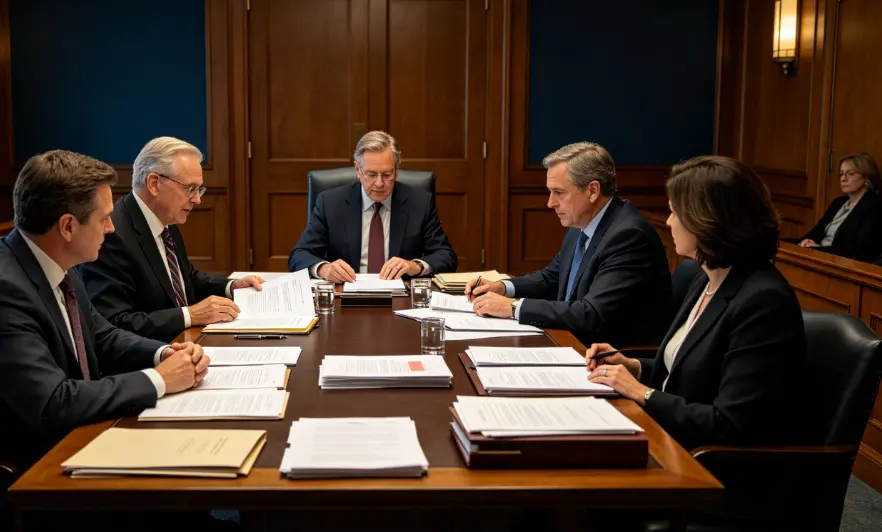

A contractor completes an industrial project in Nanjing and submits a final account that includes dozens of owner-requested variations. Many changes were discussed in site meetings and implemented immediately, but formal change orders were not consistently signed. The owner argues that the extra work was included in the lump-sum price. The contractor's problem is therefore evidentiary: it must prove instruction, performance, quantity and valuation for each disputed variation.
The Civil Code governs construction contracts, and Supreme People's Court judicial interpretations on construction contract disputes address recurring issues concerning contract validity, project price, payment and related claims. In an unsigned-variation dispute, the contract's written-change mechanism remains important, but the factual record concerning instructions, authority, performance, acceptance and valuation can determine whether the contractor has a viable additional-payment claim.
The specific issue
The Legal Rule
In Chinese Construction Disputes, treat unsigned variation work as a question of proving additional payment when the owner rejects the final account. Naming the city does not replace the papers, approvals or forum that actually control the outcome.
The Business Impact
In Chinese Construction Disputes, confirm the documents, authority and local filings for this unsigned variation work matter before you pay, transfer or sue. The city name is not a substitute for the file.
1. Start with the contract's price and variation mechanism
Begin with the contract’s pricing structure and variation clause: lump sum, unit rates, provisional sums, remeasurement or a hybrid. The legal route for unsigned extras depends on how the contract says changes are instructed, measured and valued. Argument that ignores the clause and jumps to “fair price” usually wastes the strongest contractual tools.
2. Break the claim into individual variations rather than one global extra-work number
Break the claim into individual variation items with separate instruction, performance, quantity and valuation proof. One global “extra work” number invites the owner to attack the weakest component and collapse the entire claim. Itemization also enables settlement of strong items while isolating weak ones.
3. Build an instruction chain from drawings, meeting minutes, email and site notices
Build an instruction chain for each item from drawings, RFIs, meeting minutes, emails, WeChat records and site notices. Unsigned site instructions can still be persuasive when corroborated by a consistent documentary trail showing the owner directed the work.
4. Prove actual performance with logs, photographs, inspection and acceptance records
Prove actual performance with daily logs, photographs, inspection records, delivery notes and acceptance documents tied to each variation. Courts and arbitration panels discount claims that show only an instruction without evidence the work was done.
5. Prove quantities using contemporaneous measurement records where possible
Prove quantities from contemporaneous measurement records, joint surveys or agreed take-offs. Reconstructed quantities prepared years later for litigation are weaker than site measurements made when the work was visible. Where joint measurement was refused, record the refusal.
6. Prove valuation using contract rates, agreed prices or expert appraisal
Value each item using contract rates, prior agreed change prices or, where necessary, expert appraisal anchored to the contract’s valuation rules. Do not leap to an unsupported market price when the contract provides a rate mechanism.
7. Analyze the authority of the owner's site representatives
Analyze whether the person who directed the work had actual or apparent authority under the contract and project practice. Owner-side site representatives often bind the owner through course of dealing even when formal variation forms were ignored—if the evidence shows habitual reliance.
8. Explain missing signatures through course of dealing and corroborating evidence
Explain missing signatures with course-of-dealing evidence: prior unsigned changes that were paid, meeting minutes acknowledging the work, or owner-driven schedule pressure that bypassed paperwork. Absence of a form is a fact to overcome, not an automatic bar, but it must be addressed item by item.
9. Preserve every final-account submission and owner response
Preserve every final-account submission, owner response, deduction notice and meeting note. Final-account disputes are often won or lost on who made what claim when, and whether the owner objected with reasons or simply stopped paying.
10. Analyze the contractual effect of third-party audit reports
Determine the contractual status of third-party audit or cost-consultant reports. Some are binding determination mechanisms; others are advisory. Misreading an audit as conclusive—or ignoring a binding one—can sink an otherwise evidenced variation claim.
11. Separate variation payment from delay and extension-of-time claims
Separate variation payment claims from delay and extension-of-time claims even when they arise from the same events. Mixing prolongation costs into unsigned variation valuations creates proof and causation problems. Keep time and money theories distinct, then show links where the contract requires.
12. Prepare for quality counterclaims and rectification evidence
Anticipate quality counterclaims and assemble rectification, inspection and acceptance evidence for the same work packages. Owners frequently answer variation claims with defect allegations; the contractor should not discover its quality file only after the counterclaim arrives.
13. Preserve records before project personnel leave or systems are archived
Image project servers, collect phones and laptops from departing staff and export chat groups before personnel demobilize. Variation disputes filed a year later often fail because the informal instructions lived only in ephemeral messages.
14. Use expert appraisal strategically rather than as a substitute for missing facts
Use expert appraisal to value or explain technical issues after the factual instruction-and-performance record is assembled. Experts cannot repair a missing instruction chain; they can support quantum and technical necessity once facts exist.
15. Create a variation claim schedule with evidence references
Create a claim schedule listing each variation, instruction evidence, performance evidence, quantity basis, valuation basis and owner response. The schedule is the working tool for negotiation, mediation and pleading.
16. Rank strong and weak items for settlement leverage
Rank items by evidential strength for settlement leverage. Settle or drop weak items early; concentrate hearing time on items with clean instruction-performance-quantity-price chains. A refusal to triage signals to the tribunal that the contractor cannot distinguish proof from aspiration.
17. Map assets and enforcement before filing a large claim
Map the owner’s reachable assets, guarantees and payment channels before filing a large claim. A favorable award against an empty project company is a hollow victory. Enforcement strategy should shape respondent selection and interim measures.
18. Use a hypothetical industrial project with 60 disputed changes
In a typical industrial project with dozens of disputed changes, require counsel and the commercial team to score each of the sixty items against the four-proof test before issuing a demand. The exercise usually cuts the claim to a smaller, credible set and improves recovery prospects.
19. Redesign future projects with digital change-order controls
Redesign future projects with digital change-order workflows, mandatory photo measurement points and dual sign-off for site instructions. Litigation lessons that never enter the next contract’s administration process will be repeated.
20. Require every claimed amount to link to instruction, performance, quantity and price evidence
Impose an internal rule that no claimed amount reaches the demand letter unless it links to instruction, performance, quantity and price evidence. Claims that fail the link stay in reserve or are written down before they damage credibility.
Worked scenario: sixty variations and only twenty signed change orders
Assume a mechanical and electrical contractor completes a semiconductor facility. During construction, the owner repeatedly changes routing, equipment specifications and clean-room requirements. Sixty items appear in the contractor's final variation schedule. Twenty have formal signed change orders. The remaining forty are supported by combinations of revised drawings, site meeting minutes, emails, inspection records and photographs. The owner rejects most of the claim and argues that the lump-sum price covered all necessary work.
The contractor should not litigate the forty unsigned items as a single block. Each variation needs a mini-file. The first question is scope: what did the original contract and tender drawings require? The second is instruction: who requested or approved the change, and what authority did that person appear to have? The third is performance: what evidence proves the additional work was actually executed? The fourth is quantity and price.
Some items may be strong even without a signed form. A revised owner-issued drawing followed by site installation, inspection and acceptance can create a coherent evidentiary chain. Other items may be weak if the only evidence is the contractor's own cost sheet created after completion. The claim schedule should grade the strength of each item and identify missing proof.
Expert appraisal can help with quantity and valuation but should not be asked to invent the factual basis of the variation. The contractor should provide the expert with a clean set of drawings, measurements and agreed rates. Where the contract contains a hierarchy for pricing changes, that method should be applied before resorting to market rates.
The owner may respond with delay or quality counterclaims. The contractor should therefore separate variation cost from extension-of-time claims and preserve rectification and acceptance evidence. Settlement strategy should focus on the strongest items first rather than insisting that every line of the final account is equally defensible.
The litigation team should also map enforcement. A technically strong claim against an undercapitalized project company may need security, guarantee or asset-preservation analysis from the outset.
Action checklist before implementation
- Confirm who has authority to issue the demand and settle individual variation items.
- Assemble the core evidence set: contract, variation clause, instruction chain, performance records, measurements, valuation basis, final-account submissions and owner responses.
- Identify the weakest high-value item and decide whether to drop or bolster it first.
- Quantify strong versus weak claim value for settlement strategy.
- List third parties needed for proof—site staff, consultants, auditors or subcontractors.
- Define the fallback if key witnesses or systems are about to demobilize.
- Reconcile claim schedule totals with accounting receivables.
- Assign owners for evidence collection on each ranked item.
- Ensure demand letters do not over-claim weak items.
- Retain an enforcement map before filing.
Quality-control questions
Before the matter is closed, an independent reviewer should be able to reconstruct instruction, performance, quantity and price evidence for each pursued variation item. The reviewer should explain why the team avoided presenting one global claim for extra work without a scored evidence schedule. If that explanation depends on recollection rather than the file, the work is not complete.
Decision tree for each disputed variation
The contractor should ask four questions for every variation. First, was the work outside the original scope? Second, who instructed or accepted the change? Third, what evidence proves the additional work was performed and in what quantity? Fourth, what contractual or evidentiary basis supports the price claimed? If one of these links is missing, the claim should be graded as weak until the gap can be filled.
Authority should be analyzed carefully. A site engineer may have authority to coordinate technical work but not to increase price. Yet repeated owner acceptance of that person's instructions may form part of the factual case. Counsel should review the contract, appointment letters, meeting practice and prior paid variations to understand the course of dealing.
Quantity evidence should be as contemporaneous as possible. Measurements created years later for litigation are weaker than signed site records, inspection data, material deliveries and as-built drawings. Where the physical work can still be inspected, expert measurement may help. Where the work is concealed, the historical record becomes even more important.
Pricing should follow the contractual hierarchy. Existing bill rates may apply to similar work; agreed rates may govern some categories; and expert appraisal may be needed for genuinely new scope. The contractor should not apply a single unsupported markup to every variation.
Litigation claim schedule
The claim schedule should contain a row for each variation with columns for original scope reference, instruction evidence, performance evidence, quantity, price basis, owner response, current claim amount and evidentiary strength. That table should drive both pleadings and settlement.
Strong items should be separated from weak ones. A contractor may improve settlement leverage by conceding speculative claims and focusing expert resources on well-documented variations. Conversely, an owner may identify accepted or paid-in-part items that should not be contested merely to reduce the headline claim.
Delay and quality issues should be scheduled separately. If a variation caused time impact, the contractor should connect it to the critical path rather than assume every extra item justifies an extension. If the owner alleges defects, the contractor should preserve rectification and acceptance evidence.
Before filing, counsel should review security and enforcement options. A large project-price award is only useful if the defendant or guarantor can satisfy it. Guarantees, retention, project assets and other security arrangements should be analyzed from the outset.
Evidence triage before construction litigation begins
The contractor should rank evidence by independence and contemporaneity. Owner-issued revised drawings, signed meeting minutes, third-party inspection records and contemporaneous measurements generally provide a stronger foundation than the contractor's own retrospective spreadsheet. That does not mean internal records are useless, but they should be corroborated wherever possible.
Witness evidence should be preserved before the project team disperses. Site engineers may remember who instructed a change, why it was necessary and how quantities were measured. Counsel should interview them while records are still available and test their recollection against documents rather than relying on memory alone.
Digital evidence should also be collected in a usable form. Project management systems, email, messaging platforms and BIM records may contain instructions and timestamps. Screenshots without metadata can be difficult to authenticate, so the litigation team should preserve source files where possible.
Before filing, the contractor should create a proof matrix for each major variation. If a claimed amount lacks one of the four links—scope change, instruction, performance, valuation—the team should decide whether additional evidence can cure the gap, whether expert appraisal may assist, or whether the item should be reduced or abandoned. That discipline can materially improve both pleadings and settlement credibility.
Settlement preparation
A credible settlement position should be built from the proof matrix rather than a percentage discount applied to the total final account. The contractor should identify which variations have complete documentary chains, which depend on witness evidence, and which require appraisal. That allows counsel to negotiate from the strongest items first and avoid weakening the overall case by defending poorly supported amounts with the same intensity as well-documented work.
Claim presentation discipline
The statement of claim and supporting schedule should use the same numbering for every variation from first demand through expert appraisal and hearing. Renumbering or combining items during the dispute creates confusion and can make evidence difficult to trace. A stable claim architecture also helps the court, expert and settlement team distinguish admitted work from genuinely disputed scope.
Conclusion
This issue should be managed as a specific legal-control problem. The legal framework must be applied to verified facts and converted into an executable sequence. The central lesson from this scenario is to avoid presenting one global claim for 'extra work' without a schedule linking each amount to instruction, actual performance, quantity and price evidence. A strong file shows the legal rule, the commercial decision, the supporting evidence and the fallback if the preferred route fails.
Legal and regulatory sources
[1] Civil Code of the PRC — official NPC legal database: https://flk.npc.gov.cn/ [2] Supreme People's Court judicial interpretations and construction dispute materials: https://www.court.gov.cn/
This article is general legal information and is not legal advice for a specific matter.
Discussion
Share experience or questions about this topic. This is a public discussion — not legal advice. Do not post confidential case details.
Have a question after reading? Leave it here, or Ask a Lawyer for a free initial intake.
Comments are moderated. China Legal Portal is a directory and information resource; no attorney–client relationship is formed by posting here.