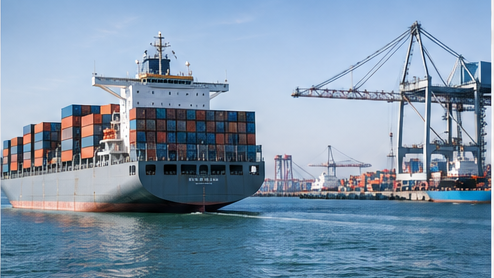

When cargo arrives damaged at a Chinese port, one question immediately dominates the dispute: Who is legally responsible for the loss?
The answer is often more complicated than the commercial parties expect. The seller may blame the carrier. The carrier may blame the shipper’s packaging. The freight forwarder may argue that it was only an agent. The consignee may claim against the contractual carrier while the actual sea transport was performed by another company. The cargo insurer may pay the insured and then pursue recovery by subrogation.
In 2026, these disputes must also be analyzed against China’s newly revised Maritime Law, which took effect on May 1, 2026. The revised law updates the carriage-of-goods framework, recognizes electronic transport records, and adjusts rights and responsibilities across maritime transactions.
This article explains how cargo-damage liability is analyzed under a bill of lading in China.
1. Start With the Transport Contract
A bill of lading is not merely a receipt. It can perform multiple legal functions, including evidencing the contract of carriage and representing rights connected with the goods.
The first task in a cargo claim is to identify the contractual carrier. The name on the ship, the company that issued the bill, the freight forwarder, and the company that physically carried the goods may not be the same.
Claims should be directed against the correct party.
2. Contractual Carrier vs. Actual Carrier
International shipping often involves subcontracting. A contractual carrier may undertake responsibility to the shipper but perform all or part of the carriage through an actual carrier.
Chinese maritime law addresses responsibility involving carriers and actual carriers. In appropriate circumstances, claims may involve one or both.
The claimant should therefore obtain the complete bill of lading and identify:
- the issuer;
- the named carrier;
- vessel details;
- any “as agent for carrier” wording;
- charter-party references;
- Himalaya or subcontracting clauses;
- jurisdiction and arbitration clauses.
3. The Carrier’s Period of Responsibility
Cargo claims depend on when the damage occurred. The carrier is not necessarily responsible for every event from factory departure to final warehouse delivery.
The applicable responsibility period depends on the contract, mode of transport, and law. Container shipments, port-to-port carriage, and multimodal transport can create different questions.
A claimant should reconstruct the cargo condition at each stage:
- before loading;
- at carrier receipt;
- at loading;
- during the voyage;
- at discharge;
- at delivery.
This timeline is often decisive.
4. What Must the Cargo Claimant Prove?
The claimant normally needs to establish that the goods were delivered into the relevant transport chain in sound condition and were damaged during the carrier’s responsibility period.
Useful evidence includes:
- clean bills of lading;
- pre-shipment inspection reports;
- loading photographs;
- packing records;
- container inspection records;
- seal numbers;
- temperature logs;
- discharge surveys;
- joint inspection reports;
- delivery receipts;
- photographs of damaged cargo;
- repair or salvage records.
Evidence should be collected immediately. Cargo conditions change quickly after discharge.
5. The Importance of Survey Reports
An independent marine survey is often one of the most important pieces of evidence in a cargo-damage claim.
The surveyor may record the nature, extent, and apparent cause of damage. For refrigerated cargo, temperature data may be critical. For machinery, impact or moisture evidence may matter. For steel, rust patterns and seawater testing can be relevant.
The survey should be commissioned promptly and, where possible, the carrier or its representative should be invited to attend.
6. Carrier Liability Is Not Absolute
The carrier is not automatically liable whenever cargo is damaged.
China’s revised Maritime Law provides circumstances in which a carrier may avoid liability for loss, damage, or delay occurring during the responsibility period. These include specified maritime risks and other causes recognized by the law.
The precise defense must be evaluated against the facts.
7. Nautical Fault and Maritime Defenses
The revised Chinese framework continues to contain defined defenses connected with navigation or management of the vessel, fire, sea perils, war, government action, strikes, rescue operations, and other causes.
A carrier cannot simply invoke “bad weather” without evidence. The carrier must establish the factual basis for the relevant defense.
Claimants should obtain voyage records and weather data where a maritime peril is alleged.
8. Inadequate Packaging
Poor packaging is a common defense.
The shipper has responsibilities concerning proper packaging and accurate cargo information. If damage is caused by inadequate packaging, the carrier may argue that it should not bear liability.
This is especially important for machinery, glass, furniture, chemicals, and moisture-sensitive goods.
Exporters should retain packaging specifications, photographs, and supplier records.
9. Inherent Vice
Some cargo deteriorates because of its own natural characteristics. Agricultural products, chemicals, metals, and other goods may be affected by inherent vice.
The legal question is whether the damage resulted from the nature of the goods rather than carrier fault.
Expert evidence may be necessary.
10. Dangerous Goods
Shippers have strict responsibilities when tendering dangerous goods. They must comply with packaging, marking, labeling, and information requirements.
If the shipper fails to disclose the dangerous nature of the goods, serious liability can result.
The revised Maritime Law expressly addresses shipper responsibilities for dangerous cargo and permits protective action by carriers in defined circumstances.
11. Delay Claims
Cargo may arrive physically intact but commercially useless because of delay.
Under the revised Maritime Law, delay can create liability in defined circumstances. The claimant should examine whether the contract specified a delivery period and whether the carrier can rely on a statutory defense.
Economic loss from delay should be documented carefully.
12. How Are Damages Calculated?
The revised Maritime Law provides principles for calculating cargo loss and damage. Loss may be measured by the actual value of the goods, while damage may be assessed based on the difference in value or reasonable repair cost depending on the circumstances.
Claimants should preserve invoices, market-price evidence, repair quotations, salvage records, and insurance documents.
13. Liability Limits
Maritime law commonly permits carriers to limit liability in certain circumstances.
The claimant should review the applicable statutory limit and any bill-of-lading provisions. The calculation may depend on packages, shipping units, or weight.
This can significantly affect high-value cargo claims.
14. When Can the Carrier Lose the Right to Limit Liability?
In serious cases involving intentional or reckless conduct meeting the legal standard, a carrier may lose the benefit of limitation.
This is fact-sensitive and should not be alleged casually. Evidence of internal knowledge, repeated warnings, or deliberate operational decisions may become relevant.
15. Package and Shipping Unit Problems
Containerized cargo creates recurring disputes about what counts as a package or shipping unit for limitation purposes.
The wording of the bill of lading matters. If individual packages are enumerated, the analysis may differ from a bill describing only one container.
Shippers should ensure the transport document accurately describes package numbers.
16. Clean Bill of Lading
A clean bill of lading can support the proposition that the cargo appeared to be in good order and condition when received or loaded, subject to the nature of the statement.
However, a clean bill does not prove hidden internal condition.
For cargo susceptible to concealed damage, pre-shipment surveys may still be necessary.
17. Freight Forwarder Liability
One of the most difficult questions is whether the freight forwarder is liable as carrier or merely as agent.
The answer depends on what the forwarder actually did and what documents it issued. If it issued a house bill of lading in its own name and assumed transport responsibility, it may face carrier-type liability. If it merely arranged transport on behalf of the shipper, the analysis may differ.
Courts look at substance, not just labels.
18. NVOCC Issues
Non-vessel-operating common carriers can occupy an important position in container shipping.
Cargo interests should review whether the NVOCC issued its own bill, contracted with the ocean carrier, and assumed obligations toward the shipper.
Claims may need to address both the NVOCC and the vessel-operating carrier.
19. Multimodal Transport
Many modern shipments include road, rail, and sea legs under one logistics arrangement.
If the place of damage can be identified, the applicable liability regime may depend on that transport stage. If the place cannot be identified, the contract and relevant multimodal rules become important.
The revised Maritime Law includes specific provisions relevant to multimodal transport.
20. Electronic Bills and Transport Records
The 2026 Maritime Law expressly recognizes electronic transport records, reflecting the digitalization of shipping.
Businesses using electronic bills should ensure that their systems can demonstrate authenticity, control, transfer, and integrity of the record.
Digitalization changes the document form but not the need for reliable evidence.
21. Notice of Damage
Cargo interests should provide notice of loss or damage promptly and in accordance with the applicable law and transport terms.
Failure to provide timely notice can create evidentiary problems even if it does not automatically eliminate every claim.
The safest practice is to notify the carrier immediately when damage is discovered.
22. Time Limits for Claims
Maritime claims are subject to specific limitation periods. These can be shorter than ordinary commercial claims.
Claimants should identify the deadline as soon as cargo damage occurs. Negotiation with the carrier or insurer should not be allowed to consume the limitation period without a clear legal strategy.
23. Jurisdiction and Arbitration Clauses
Bills of lading frequently contain forum clauses. A dispute may be subject to a Chinese maritime court, foreign court, or arbitration agreement.
Before filing, counsel should review:
- the bill of lading;
- charter-party incorporation language;
- booking terms;
- jurisdiction clauses;
- arbitration clauses;
Filing in the wrong forum wastes time and may threaten limitation deadlines.
24. Maritime Courts in China
China has specialized maritime courts that handle significant categories of maritime and shipping disputes.
Where Chinese jurisdiction applies, these courts offer specialist experience in bills of lading, cargo claims, charter parties, collisions, marine insurance, and other maritime matters.
The correct maritime court depends on jurisdictional rules and the facts of the case.
25. Cargo Insurance and Subrogation
Many cargo claims involve insurers. If an insurer compensates the insured, it may acquire subrogation rights against the responsible carrier or other party.
The insured should preserve documents needed for the insurer’s recovery action, including the policy, proof of payment, bill of lading, survey report, and claim correspondence.
Poor evidence handling can reduce both insurance recovery and subrogation prospects.
26. Incoterms Do Not Decide Carrier Liability
A common misunderstanding is that CIF, FOB, or another Incoterm determines whether the carrier is liable.
Incoterms primarily allocate responsibilities, costs, and risk between seller and buyer under the sale contract. Carrier liability arises under the carriage contract and applicable law.
Both analyses may be relevant, but they answer different questions.
27. Example: CIF Shipment Arrives Wet
Assume a Chinese seller ships machinery CIF to a foreign buyer. The goods arrive with severe seawater damage.
The buyer may have borne transit risk under the sale contract after shipment, but it can still pursue insurance and potentially carrier claims depending on the facts. The seller may need to cooperate with documentation.
The cargo claim should examine packaging, container condition, stowage, voyage records, survey findings, and carrier defenses.
28. Example: Reefer Cargo Spoils
A refrigerated container of food arrives at a Chinese port spoiled.
Key evidence may include set temperature, actual temperature logs, power interruptions, pre-cooling records, container maintenance records, and time of delivery.
The carrier may allege inherent vice or improper pre-shipment temperature. The cargo owner may allege equipment failure or delay.
Technical evidence will likely decide the case.
29. Example: Freight Forwarder Issues House Bill
A freight forwarder issues its own house bill of lading and contracts with an ocean carrier under a master bill.
If cargo is damaged, the shipper may have a contractual claim against the forwarder under the house bill, while the forwarder may pursue the ocean carrier.
The identities and document chain should be analyzed carefully.
30. IP Problems at the Port
Cargo can also be delayed or detained because of intellectual-property issues.
Chinese customs authorities may take measures in relation to goods suspected of infringing registered IP rights. Exporters using third-party brands should therefore confirm trademark authorization before shipment.
A maritime lawyer handling trade disputes should consider whether a port delay is truly a carriage issue or an IP/customs issue.
31. Practical Cargo-Damage Checklist
When damaged cargo is discovered:
- Photograph the goods immediately.
- Preserve packaging and seals.
- Notify the carrier and insurer.
- Arrange an independent survey.
- Invite relevant parties to joint inspection.
- Obtain the full bill-of-lading set.
- Collect commercial invoices and packing lists.
- Preserve temperature or container data.
- Identify the contractual and actual carrier.
- Review jurisdiction and arbitration clauses.
- Calculate limitation deadlines.
- Quantify loss and salvage value.
- Avoid disposing of evidence prematurely.
- Coordinate insurance and legal claims.
32. Frequently Asked Questions
Is the shipping line always liable for damaged cargo?
No. Liability depends on the period of responsibility, cause of damage, applicable defenses, and evidence.
Can I sue the freight forwarder?
Possibly, especially if the forwarder acted as contractual carrier or breached its own obligations. The exact role must be examined.
Does a clean bill guarantee recovery?
No. It is useful evidence but does not prove every aspect of cargo condition or causation.
Can the carrier limit liability?
Often yes, subject to statutory conditions and exceptions.
Does insurance replace the carrier claim?
No. Cargo insurance and carrier liability are separate. After payment, the insurer may pursue subrogation.
What if I discover damage after leaving the port?
Notify the carrier and insurer immediately and preserve evidence. Delayed discovery makes causation more difficult to prove.
Conclusion
Liability for cargo damage under a bill of lading in China depends on much more than identifying that the goods arrived damaged. The claimant must determine who acted as contractual and actual carrier, when the damage occurred, what caused it, whether a legal defense applies, how loss should be calculated, and whether limitation or forum clauses affect the claim.
China’s revised Maritime Law, effective May 1, 2026, makes this an especially important time for exporters, importers, carriers, freight forwarders, insurers, and logistics companies to review their transport documents and claims procedures.
The most effective cargo claims begin with immediate evidence preservation and a clear map of the contractual relationships. In maritime disputes, the documents and the first days after discovery often determine the final result.
This article is for general informational purposes only and does not constitute legal advice. Maritime liability depends on the specific transport documents, cargo, route, facts, applicable law, and dispute forum. \n\n## 33. Additional Questions in Cargo Claims\n\n### Who should receive the first notice of claim?\n\nThe safest approach is usually to notify all potentially responsible transport parties promptly: the contractual carrier, actual carrier where known, freight forwarder, NVOCC, terminal or warehouse if relevant, and cargo insurer. The notice should identify the shipment, bill of lading, nature of damage, discovery date, and reservation of rights. Early notice helps preserve evidence and prevents later arguments that a party was denied an opportunity to inspect.\n\n### Should the damaged cargo be sold as salvage immediately?\n\nNot before the evidence position is protected. Commercial mitigation is important, and cargo owners should not allow avoidable losses to increase. But disposing of the goods before survey, photographs, sampling, or joint inspection can make causation and quantum difficult to prove. The claimant should coordinate with the insurer, surveyor, and legal counsel before salvage disposal.\n\n### What if the bill of lading contains foreign law and foreign jurisdiction?\n\nThe clause must be reviewed carefully. Its validity and effect may depend on the wording, the parties, the type of bill, and mandatory legal rules. A claimant should not ignore a foreign forum clause simply because the cargo was discharged in China. Conversely, the existence of a printed clause does not always end the jurisdiction analysis. Maritime counsel should review it before limitation time is lost.\n\n### Can email and electronic platform records prove the transport contract?\n\nYes, electronic evidence can be important, especially in booking and freight-forwarding disputes. Booking confirmations, electronic bills, platform messages, invoices, freight quotations, and payment records may help establish which party undertook carrier responsibility. The revised Maritime Law’s recognition of electronic transport records makes digital evidence even more central to modern shipping practice.\n\n### What if the carrier says the container was sealed and therefore it cannot be responsible?\n\nA seal proves certain aspects of container integrity but does not resolve every cause of damage. Water ingress, reefer malfunction, improper stowage, excessive movement, delay, or other events can occur without an obvious seal problem. The technical evidence must be examined.\n\n## 34. Claims Involving High-Value or Sensitive Cargo\n\nHigh-value machinery, pharmaceuticals, electronics, temperature-controlled food, chemicals, and branded consumer goods require more disciplined pre-shipment evidence. For these cargoes, parties should consider independent loading surveys, shock or tilt indicators, temperature monitoring, detailed packaging specifications, and written carriage instructions. The additional cost is often small compared with the evidentiary value if a major loss occurs.\n\nBranded goods create an additional issue: customs or intellectual-property disputes can interrupt delivery even where the carrier performs properly. Exporters should ensure trademark authorization, licensing documents, and customs IP registrations are aligned with the shipment.\n\n## 35. A Carrier-Contract Review Checklist Before Shipment\n\nShippers can reduce future disputes by reviewing transport terms before booking. Confirm the identity of the contractual carrier, liability and limitation clauses, declared-value options, dangerous-goods provisions, reefer instructions, deck-carriage terms, jurisdiction or arbitration clauses, and notice requirements. For freight-forwarder bookings, determine whether the forwarder will act as agent or issue its own house bill and assume carrier obligations.\n\nThe cheapest freight quote is not always the lowest-risk transport contract.\n\n## 36. A Practical Dispute Strategy\n\nOnce a significant cargo loss occurs, the claimant should run three workstreams in parallel. The first is evidence: survey, photographs, transport records, packaging, and causation. The second is legal: responsible parties, applicable law, defenses, liability limits, forum, and limitation period. The third is commercial: insurance notification, salvage, customer communication, and settlement strategy.\n\nTreating these workstreams separately often causes mistakes. A commercial team may dispose of goods that the legal team needed as evidence. An insurer may request documents that operations did not preserve. A lawyer may focus on liability while the company fails to mitigate loss. Coordinated response is therefore one of the most important features of a successful maritime claim.\n
Discussion
Share experience or questions about this topic. This is a public discussion — not legal advice. Do not post confidential case details.
Have a question after reading? Leave it here, or Ask a Lawyer for a free initial consultation.
Comments are moderated. China Legal Portal is a directory and information resource; no attorney–client relationship is formed by posting here.