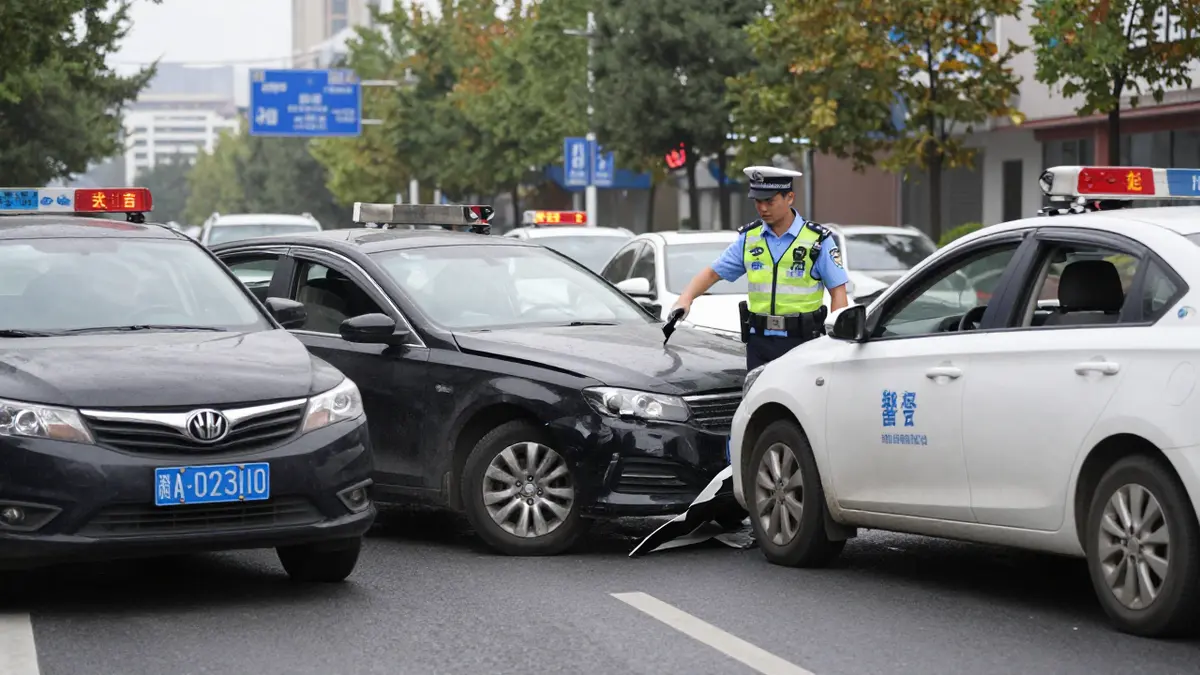

Traffic Accidents Involving Foreign Nationals in China: Legal Procedures and Compensation
The Legal Rule
In China, treat traffic accidents involving foreign nationals as a question of legal procedures and compensation. Naming the city does not replace the papers, approvals or forum that actually control the outcome.
The Business Impact
In China, confirm the documents, authority and local filings for this traffic accidents involving foreign nationals matter before you pay, transfer or sue. The city name is not a substitute for the file.
When a foreign national is involved in a traffic accident in China — whether as a victim, driver, or pedestrian — the legal procedures differ in several important respects from those applicable to Chinese citizens. China's traffic accident laws apply equally to all persons within its territory, but special rules govern jurisdiction, documentation, compensation standards, and enforcement of judgments when foreign parties are involved. This article provides a comprehensive overview of what foreign nationals need to know.
Applicable Law and Jurisdiction
Under Chinese conflict of laws rules, tort liability arising from a traffic accident is governed by the law of the place where the accident occurred. This means Chinese substantive law applies to accidents on Chinese roads regardless of the nationality of the parties involved. The Civil Procedure Law grants foreign nationals the same right to sue and be sued in Chinese courts as Chinese citizens, subject to the principle of reciprocity. However, certain procedural requirements apply specifically to foreign litigants, including the mandatory engagement of Chinese-licensed lawyers and the authentication of documents executed abroad.
Jurisdiction over traffic accident claims generally lies with the court of the defendant's domicile or the place where the accident occurred. For accidents involving foreign defendants with no fixed domicile in China, the plaintiff may file in the place where the accident occurred or where the defendant's property is located.
Compensation Standards for Foreign Victims
Chinese courts generally apply the compensation standard of the court's locality when calculating damages for foreign victims. However, courts have discretion in cases where the victim's home country standard differs significantly from the Chinese standard. Higher courts in several provinces have issued guidance on this point. The Fujian Higher People's Court has stated that if a foreign victim can prove their domicile standard exceeds the court's locality standard, the court may apply the higher standard, but capped at China's highest domestic standard. This middle-ground approach aims to balance fair compensation for the victim against the burden on Chinese defendants.

- FAILURE MODES
In a significant 2009 case decided by the Nanchang Intermediate People's Court in Jiangxi Province, the court applied Shanghai's compensation standard — then the highest in China — to a foreign victim from a developed country, rather than applying the much lower local Jiangxi standard. This case established an important precedent that has been followed by other courts in similar circumstances.
Special Rules for Foreign Drivers
Foreign nationals driving in China must hold a valid Chinese driver's license or a valid foreign license with an International Driving Permit recognized by Chinese authorities. Driving with only a foreign license without proper endorsement constitutes unlicensed driving under Chinese law. In a 2011 case from Zhejiang Province, a Pakistani citizen who caused a fatal accident while driving on his Pakistani license was found to be driving without a valid license, and the insurance company was entitled to recover its payout from him after compensating the victim's family.
Foreign drivers involved in accidents should be aware that the traffic police may impose travel restrictions to prevent them from leaving China before the case is resolved. If the foreign driver is suspected of a criminal offense such as hit-and-run or causing death by dangerous driving, border control measures may be implemented.
Insurance Considerations
China's compulsory traffic accident liability insurance provides baseline coverage of up to 180,000 RMB for personal injury and 2,000 RMB for property damage per incident. Commercial third-party insurance is strongly recommended, particularly for foreign drivers who may face higher compensation claims. Foreign victims should also check whether their own insurance policies provide coverage for accidents in China, as some international policies include China within their coverage area.
Practical Steps After an Accident
Foreign nationals involved in a traffic accident should take the following steps: ensure medical needs are addressed immediately; report the accident to the traffic police (dial 122) and obtain a written accident determination; document the scene with photographs and witness information; notify your insurance provider and embassy or consulate; retain all medical records and receipts; and seek legal advice before signing any settlement agreement, particularly if you do not fully understand the Chinese-language documents. The traffic police may facilitate mediation between the parties, but any settlement should be reviewed by legal counsel before execution to ensure it adequately protects your rights and does not waive future claims.
Personal Injury Application Notes
- Written engagement scope and remedy options
- Bilingual document control
- Deadline and limitation tracking
- Enforcement and settlement options in parallel
Operational Checklist for Foreign Readers
- Kickoff scope memo and remedy ladder
- Bilingual document control
- Deadline and limitation tracking
- Enforcement and settlement options in parallel
Risk Controls Before Escalation
- Documented objectives and preferred remedies
- Bilingual document control
- Deadline and limitation tracking
- Enforcement and settlement options in parallel
Practical Takeaways for Foreign Parties
- Confirm which Chinese authority or court has power over your facts before you spend on a strategy built for the wrong forum.
- Preserve contracts, payment records, chat logs and notices early; later reconstructions are weaker and more expensive.
- Separate negotiation leverage from legal entitlement. Many matters settle, but only after the file is strong enough that settlement is rational for both sides.
- Build a bilingual chronology for headquarters stakeholders so decisions are made on shared facts rather than fragmented updates.
- Ask counsel for a staged plan with deadlines: interim measures, filings, evidence collection and settlement windows.
Document Checklist
As a starting set, gather the operative agreements and amendments, invoices or payment proofs, key correspondence (including WeChat exports where relevant), corporate authority documents, and any notices already received from counterparties or authorities. Perfect organisation is not required; a partial package with a short chronology is enough to begin triage.

- Traffic Accidents Involving Foreign Nationals in China: Legal Procedures and Compensation — process. Traffic Accidents Involving Foreign Nationals in China: Legal Procedures and Compensation; — sequence; Call police and preserve scene; Compensation Standards for Foreign; Victims; Obtain the determination.
- Traffic Accidents Involving Foreign Nationals in China: Legal Procedures and Compensation — process.
- Compute heads of damage
This section is provided to help readers convert general legal information into an action list. It is not a substitute for advice on a specific matter; local procedure, evidence quality and counterparties’ positions can change the correct next step.
Discussion
Share experience or questions about this topic. This is a public discussion — not legal advice. Do not post confidential case details.
Have a question after reading? Leave it here, or Ask a Lawyer for a free initial intake.
Comments are moderated. China Legal Portal is a directory and information resource; no attorney–client relationship is formed by posting here.