
Contract law forms the backbone of commercial transactions in China. The legal framework governing contract formation, performance, and breach has evolved significantly with the implementation of the Civil Code, which consolidated and modernized prior contract law rules. Understanding these requirements is essential for anyone doing business in China.
Contract Formation Under the Civil Code
The Legal Rule
The offer must be specific, definite, and indicate the offeror's intention to be bound upon acceptance.
The Business Impact
Identify the protected asset, legal owner, territory and evidence of creation, registration or use. Weak chain-of-title records can derail licensing and enforcement before the infringement merits are even reached. Apply that to the facts of Understanding Chinese Contract Law: Formation and Breach.
The Civil Code of the People's Republic of China, effective January 1, 2021, governs contract formation through its Book Three on Contracts, which replaced the former Contract Law. A contract is formed when one party makes an offer and the other party accepts it. The offer must be specific, definite, and indicate the offeror's intention to be bound upon acceptance. An acceptance must be unconditional and mirror the terms of the offer; any modification constitutes a counter-offer. Written form is mandatory for certain contracts including real estate transactions, technology development agreements, guarantee contracts, financing leases, and contracts involving foreign parties in certain regulated sectors. Essential terms in every contract should include subject matter, quantity, quality specifications, price, performance period, place and method of performance, liability for breach, and dispute resolution mechanism.
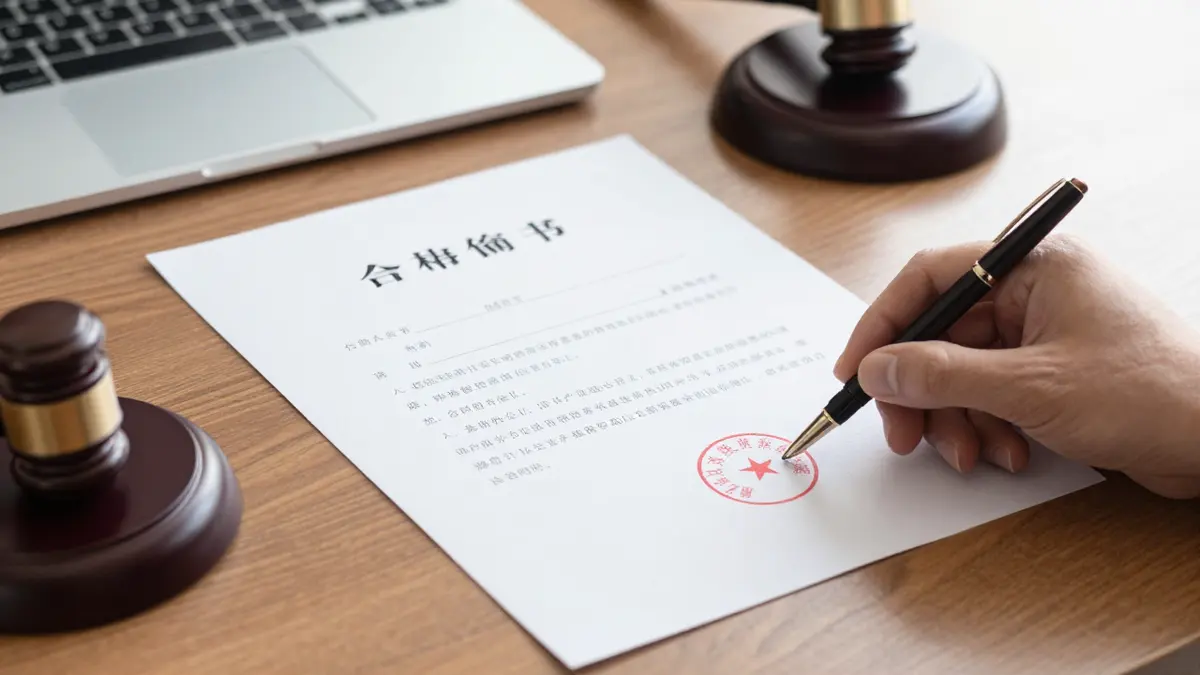
Oral contracts remain valid for many commercial transactions but present significant evidentiary challenges in disputes, particularly when large sums are involved. Foreign companies should insist on written contracts for all significant transactions and should ensure that contracts are properly signed with company seals, as Chinese commercial practice places significant weight on the company seal as evidence of a party's intention to be bound. Contracts that are signed by individuals without company seals may be challenged if the signing party's authority is disputed, making it important to verify signatory authority through board resolutions or powers of attorney.
Contract Validity and Avoidance

- Civil Code formation: offer, acceptance, chops, and when a contract is established.
- Contract Formation and Breach.
- FAILURE MODES
- Offer / acceptance
- Mirror and timing
For a contract to be valid under Chinese law, the parties must have appropriate legal capacity, the contract's purpose and content must not violate mandatory legal provisions or public policy, and the parties' expressions of intent must be genuine. Contracts that violate mandatory legal provisions are void, as are contracts that harm public interests or are entered into through malicious collusion. A contract may be voidable if entered into through fraud, duress, or material misunderstanding. The statute of limitations for claiming avoidance is three years from discovery of the grounds, with an outer limit of five years from conclusion. Chinese courts take a strict approach to contracts that circumvent regulatory requirements, and a contract structured to avoid licensing requirements may be ruled void with payments subject to disgorgement.
Foreign companies should be particularly careful about contracts in regulated industries where licensing or government approval is required. For example, contracts for providing telecommunications services, financial services, or educational services without the necessary license may be ruled void in their entirety, leaving the foreign company without legal recourse to recover payments or enforce terms. When entering into contracts in regulated sectors, it is advisable to include a severability clause that preserves the validity of the remaining provisions if any particular provision is found invalid, and to structure the transaction so that the licensed activities are clearly separated from ancillary commercial arrangements.
Performance and Breach of Contract
Under the Civil Code, parties must perform their contractual obligations fully and in good faith. If a party fails to perform or performs non-conformingly, the non-breaching party may demand continued performance, remedial measures, or damages. Liquidated damages clauses are enforceable, but courts may reduce excessive amounts. The Supreme People's Court has indicated that liquidated damages exceeding 30 percent of the actual loss may be considered excessive. Consequential damages are recoverable but must have been foreseeable at contract formation under Article 584 of the Civil Code. Force majeure provisions excuse non-performance caused by unforeseeable, unavoidable, and insurmountable events.
In practice, Chinese courts tend to award actual losses rather than enforcing agreed liquidated damages at face value. Parties should therefore ensure their contract includes clear provisions for calculating actual damages and should not rely solely on liquidated damages clauses as their remedy for breach. The COVID-19 pandemic has prompted significant judicial interpretation of what constitutes force majeure, with courts generally recognizing government-ordered lockdowns as force majeure events while being more skeptical of claims based on general economic disruption. Foreign companies should ensure their contracts contain carefully drafted force majeure clauses that address specific risks relevant to their industry and include provisions for notice obligations and mitigation measures.
Dispute Resolution in Contract Matters
Chinese contract law provides multiple dispute resolution options. Negotiation and mediation are encouraged and often required before formal proceedings. Most commercial contracts specify either arbitration or litigation. China is a signatory to the New York Convention, making Chinese arbitration awards enforceable in over 170 countries. The China International Economic and Trade Arbitration Commission is the most commonly designated arbitral body for foreign-related contracts. For litigation, cases are heard in the People's Court with jurisdiction determined by the defendant's domicile or the place of contract performance.
Foreign companies should ensure their contracts include clear governing law and dispute resolution clauses, as these provisions significantly affect enforcement outcomes. It is advisable to specify whether the Chinese or English version of a bilingual contract prevails, as language discrepancies are a common source of disputes in cross-border transactions. When choosing between arbitration and litigation, foreign companies should consider that arbitration offers confidentiality and greater flexibility in selecting arbitrators, while litigation in Chinese courts may be faster and less expensive for smaller claims. For contracts with Chinese parties where the counterparty has limited assets, the practical enforceability of any award or judgment should be a primary consideration in choosing the dispute resolution mechanism.
IP Law Application Notes
I document scope, assumptions, and decision rights at engagement start so foreign clients know what will be filed, who must approve, and when silence becomes a missed deadline.

- Contract Formation and Breach — process. Contract Formation and Breach — sequence; Identify offer and acceptance; Check required form; Verify chop/LR; Confirm essential terms; Execute.
- Contract Formation and Breach — process.
- File the original
I treat bilingual consistency as a risk control: chops, authority documents, and English summaries must tell the same commercial story.
- Mandate letter covering scope and outcomes
- Bilingual document control
- Deadline and limitation tracking
- Enforcement and settlement options in parallel
Operational Checklist for Foreign Readers
I prefer early written notices and clean evidence indexes over informal WeChat-only chains when the amount or regulatory exposure is material.
- Agreed work plan and remedy path
- Bilingual document control
- Deadline and limitation tracking
- Enforcement and settlement options in parallel
Risk Controls Before Escalation
I convert complex Chinese procedure into a dated checklist with owners for translation, notarization, and internal sign-off across time zones.
- Written engagement scope and remedy options
- Bilingual document control
- Deadline and limitation tracking
- Enforcement and settlement options in parallel
Discussion
Share experience or questions about this topic. This is a public discussion — not legal advice. Do not post confidential case details.
Have a question after reading? Leave it here, or Ask a Lawyer for a free initial intake.
Comments are moderated. China Legal Portal is a directory and information resource; no attorney–client relationship is formed by posting here.