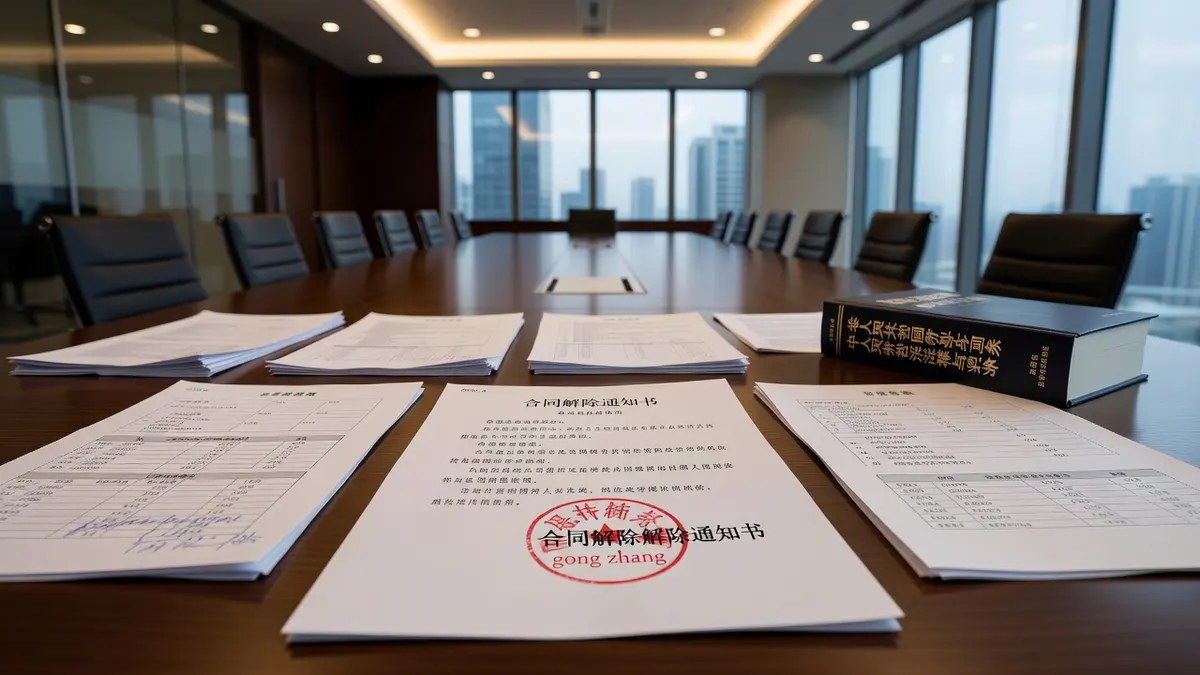

Can a foreign company terminate a Chinese employee simply because they rank at the bottom of the annual performance review? Many multinational companies operating in China assume that poor performance ratings provide sufficient grounds for dismissal. However, the Supreme People's Court of China addressed this very question in its Guiding Case No. 18 (ZTE Corporation v. Wang Peng, 2013), establishing a critical precedent that every foreign employer in China needs to understand.
The Case: ZTE Corporation v. Wang Peng
ZTE Corporation (Hangzhou), a subsidiary of the multinational telecommunications company, dismissed an employee named Wang Peng after he ranked last in the company's performance appraisal system. ZTE claimed that being ranked at the bottom demonstrated that Wang was "incompetent" for his position, justifying termination under Article 40 of the PRC Labor Contract Law.
Article 40(2) of the Labor Contract Law permits an employer to terminate a labor contract with 30 days' written notice (or pay in lieu of notice) when an employee "is not competent for the position and remains incompetent after training or adjustment of the position." ZTE argued that bottom-ranking was objective evidence of incompetence.
The court disagreed. The Supreme People's Court held that being ranked at the bottom in a performance evaluation system does not equate to "incompetence" as defined by Article 40 of the Labor Contract Law. In any ranking system, someone must be at the bottom — this is a mathematical inevitability, not a legal determination of capability.
The Legal Standard for "Incompetence" Under Chinese Law
The Supreme People's Court established that employers must meet a higher evidentiary standard before terminating based on incompetence. The employer must demonstrate that objective performance standards exist against measurable, job-relevant criteria rather than comparative rankings; that training or position adjustment was provided before termination; and that after a reasonable remediation period, the employee still fails to meet the required standards.
This three-part test creates a substantial procedural burden on employers. Simply maintaining a "rank and yank" performance management system — where the lowest-ranked employees are automatically terminated — violates Chinese labor law and exposes employers to wrongful termination claims.

- FAILURE MODES
Practical Implications for Foreign Companies in China
Foreign companies operating in China should audit their performance evaluation systems to ensure compliance with Chinese labor law standards. A system that automatically terminates the bottom 5% or 10% of performers, common practice in some Western jurisdictions, is legally problematic in China and will not withstand scrutiny before a labor arbitration committee or court.
Before terminating any employee for incompetence, maintain detailed records of the specific performance deficiencies identified, the training programs offered or completed, the new position or responsibilities assigned after retraining, and the continued performance gaps after remediation. Chinese labor arbitration tribunals place significant weight on documented evidence of procedural fairness.
Chinese labor law provides several alternative grounds for termination that may be more appropriate depending on the circumstances. Under Article 39(2), an employer may terminate for serious violation of company rules, but this requires a written, legally compliant employee handbook that has been properly communicated to all employees. Under Article 39(3), termination is possible for material breach of contract causing substantial harm, but this requires proof of actual damages. Under Article 36, a negotiated mutual agreement termination with appropriate severance is often the most practical and legally safest solution, even though it requires the employee's voluntary consent.
Wrongful termination claims in China are first heard by labor arbitration committees, not courts. The statute of limitations for filing an arbitration claim is one year from the date the employee knew or should have known of the rights violation. Foreign employers should factor in the time and cost of defending against such claims, which typically take three to six months to resolve through the arbitration process.
If a termination is found to be unlawful, Chinese courts may order reinstatement or compensation at two times the statutory severance amount. Statutory severance is calculated as one month's salary for each full year of service, with partial years prorated. For a senior employee with ten years of service earning RMB 50,000 per month, potential liability could reach RMB 1,000,000 or more — a significant financial risk that underscores the importance of getting termination decisions right.
The Bottom Line
The ZTE Guiding Case No. 18 remains good law in China and continues to shape labor arbitration and court decisions across the country. Foreign employers cannot rely on relative performance rankings as a shortcut for terminating employees. The legal standard requires a rigorous, documented process that demonstrates genuine incompetence, not merely comparative disadvantage. Given the complexity of Chinese labor law and the significant financial consequences of wrongful termination, foreign companies are strongly advised to seek qualified local legal counsel before initiating any termination proceeding.
Keywords: Labor Contract Law, China employment law, foreign employer China, employee termination China, performance review China, Article 40 Labor Contract Law, PRC labor arbitration, wrongful termination China
Employment Law Application Notes
I document scope, assumptions, and decision rights at engagement start so foreign clients know what will be filed, who must approve, and when silence becomes a missed deadline.
I treat bilingual consistency as a risk control: chops, authority documents, and English summaries must tell the same commercial story.
- Mandate letter covering scope and outcomes
- Bilingual document control
- Deadline and limitation tracking
- Enforcement and settlement options in parallel
Operational Checklist for Foreign Readers
I prefer early written notices and clean evidence indexes over informal WeChat-only chains when the amount or regulatory exposure is material.
- Agreed work plan and remedy path
- Bilingual document control
- Deadline and limitation tracking
- Enforcement and settlement options in parallel
Risk Controls Before Escalation

- Labor Contract Termination in China: What Foreign Employers Must Know About the Bottom-Ranking Myth — process. Labor Contract Termination in China: What Foreign Employers Must Know About the; Bottom-Ranking Myth — sequence; Test the statutory ground; The Legal Standard for; "Incompetence" Und…; Check notice and union steps.
- Labor Contract Termination in China: What Foreign Employers Must Know About the Bottom-Ranking Myth — process.
- Compute 2n if unlawful
I convert complex Chinese procedure into a dated checklist with owners for translation, notarization, and internal sign-off across time zones.
- Written engagement scope and remedy options
- Bilingual document control
- Deadline and limitation tracking
- Enforcement and settlement options in parallel
Discussion
Share experience or questions about this topic. This is a public discussion — not legal advice. Do not post confidential case details.
Have a question after reading? Leave it here, or Ask a Lawyer for a free initial intake.
Comments are moderated. China Legal Portal is a directory and information resource; no attorney–client relationship is formed by posting here.