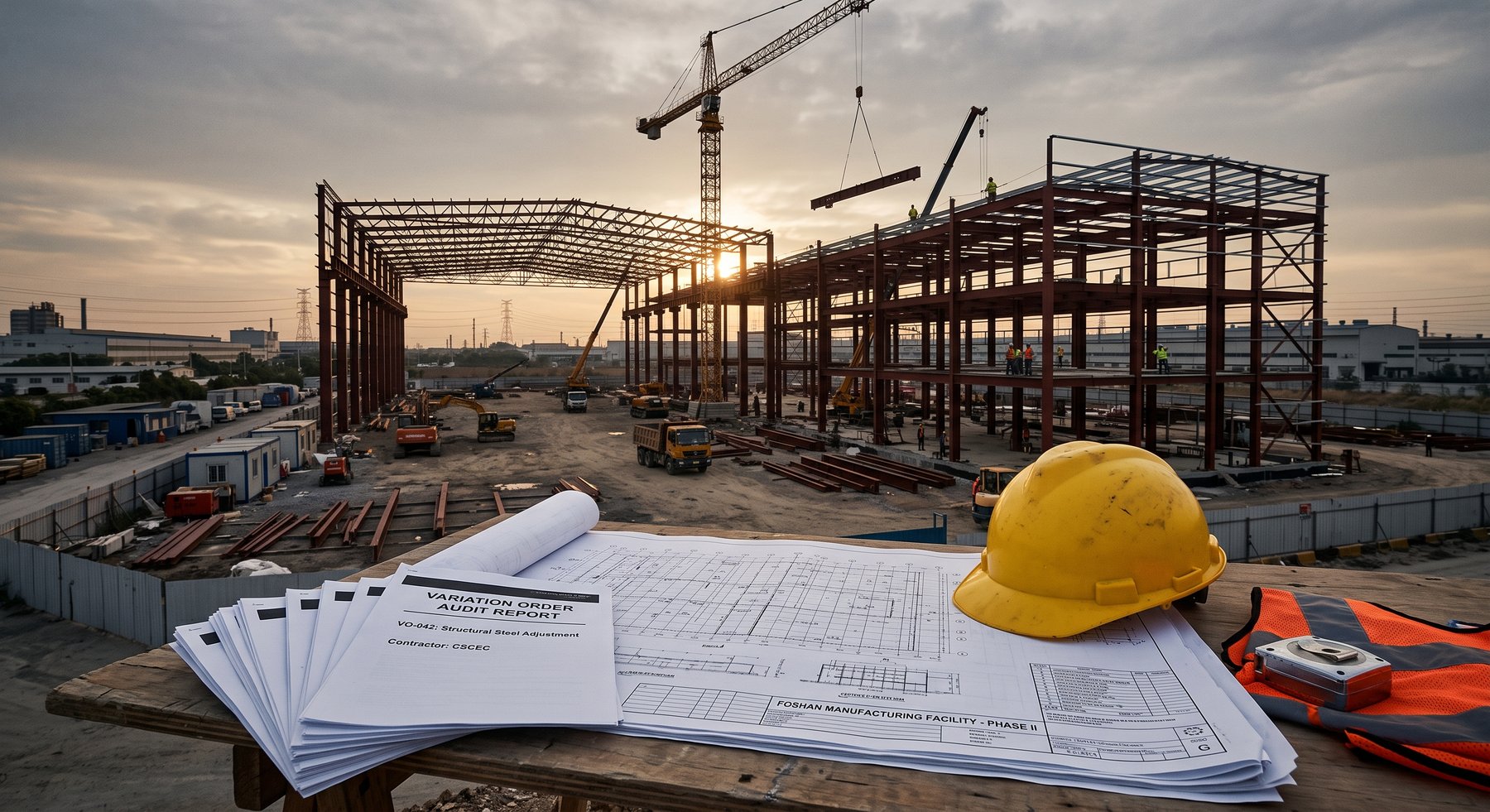

A foreign-invested manufacturer expands its Changsha factory under a lump-sum construction contract. During construction, the owner’s project manager issues revised drawings and verbal instructions to protect the schedule. The contractor performs additional MEP and civil work without obtaining signed variation orders for every change. At final account stage, the contractor claims RMB 28 million of extra work. The owner argues that the contract required written approval by a named representative and that some claimed work was already included in the lump sum. China’s Civil Code provides the contract-law foundation for construction agreements and performance, while the Supreme People’s Court’s construction-contract interpretation supplies more specific judicial rules on validity, project price, settlement and related disputes.[1][2] The outcome nevertheless depends heavily on the contract and the contemporaneous project record. The dispute has three core questions: what work was outside original scope, who had authority to instruct it, and how the price can be proved when the agreed change-order process was not followed.
The specific problem
The Legal Rule
The owner argues that the contract required written approval by a named representative and that some claimed work was already included in the lump sum.
The Business Impact
Check title/registration, permitted use, approvals, payment conditions and disclosed defects before committing funds. Contract wording can allocate risk, but it cannot create a missing property right or make an unusable site fit for purpose. Apply that to the facts of Unsigned Variation Work in a Chinese Factory Expansion: How Owners and Contractors Should Prove Scope, Price and Authority After the Project Is Built.
Scope, authority and notice
The contractor needs to not begin with a spreadsheet of additional cost. The first task is to compare the original contractual scope with the work actually performed. Relevant records include tender documents, bill of quantities, technical specifications, drawings, clarifications, scope matrices and accepted design-development obligations. A revised drawing is not automatically a compensable variation. The contract may require the contractor to develop detailed design within the original lump sum. Conversely, an owner cannot avoid payment merely by calling a material new requirement “design development” if it genuinely changes the agreed work. The dispute team should create a change register showing original requirement, revised requirement, instruction date, physical work and legal basis for claiming additional price. This scope analysis often narrows the dispute substantially before experts calculate value. Construction contracts frequently name one person who can approve changes. Site reality can be different. Owner engineers, consultants and project managers may issue daily instructions that contractors treat as binding. The legal team needs the formal authority documents and the actual course of dealing.
If the owner repeatedly paid prior changes instructed by the same project manager, that history may become relevant to the contractor’s authority argument. Still, a contractor takes risk when it knowingly bypasses clear approval limits for major extra work. The owner needs to also review internal delegation. If headquarters imposed approval thresholds but local managers ignored them, the company may have both an external dispute and an internal-control failure. Emails, messaging records, meeting minutes and progress reports can help establish who requested the work and how the parties treated the instruction at the time. Many contracts require the contractor to notify the owner within a set period after a change or event. These provisions are designed to give the owner an opportunity to review cost and schedule impact while alternatives still exist. A contractor that waits until final settlement to present dozens of claims faces an evidentiary problem even if extra work physically exists. Counsel needs to examine whether notices were given through formal letters, meeting minutes, monthly reports or other agreed channels. The legal consequence of non-compliance depends on contract wording, applicable law and the facts.
The owner’s project team can avoid assuming every late notice automatically extinguishes entitlement. The project team can avoid assuming performance alone guarantees full payment. The better analysis asks what the owner knew, what opportunity it had to object and what the contract says about notice consequences. Completed construction creates strong evidence that something was built. As-built drawings, photographs, inspection records, measurement sheets and commissioning documents can establish quantity and existence. They do not always prove that the work was outside scope or that the contractor’s claimed unit rate applies. The pricing analysis may require contract rates, agreed variation rates, market pricing, cost records or expert valuation depending on the contractual mechanism. A prudent contractor will separate direct cost from claimed overhead, profit, preliminaries and delay impact. A prudent owner will test whether omitted work or other scope reductions offset some additions. A final-account dispute is easier to manage when each variation has its own scope and pricing evidence rather than one aggregated claim.
Physical evidence, valuation and delay
A variation may add physical work without delaying completion. Another may affect the critical path even if its direct cost is modest. The contractor claiming prolongation or delay cost should connect the owner instruction to actual schedule impact. Baseline programme, updates, critical-path analysis, progress records and other delay events become relevant. The owner may argue that contractor delay, procurement problems or concurrent events caused the same period of delay. The construction claim should therefore distinguish variation price from time-related consequences. Mixing every cost into one “extra work” figure makes both negotiation and expert analysis harder. Main contractors often support variation claims with subcontractor quotations. Those documents can show market cost or actual expenditure, but the owner is not automatically bound by a subcontractor’s price. The main contract governs the owner’s payment obligation. Counsel can review whether the subcontractor scope matches the claimed variation, whether the cost was actually incurred and whether the main contractor applied markups permitted by the contract. The owner may request invoices, payment records and competitive quotations for large changes.
The contractor needs to preserve procurement records contemporaneously because reconstructing them years later is difficult. Transparent cost evidence strengthens negotiations even where the contract ultimately uses a different valuation formula. Assume the owner decides mid-project to expand a controlled-environment area and changes utility specifications. The project manager sends revised drawings through the project platform and tells the contractor to proceed immediately to avoid delaying imported equipment installation. The contractor issues a cost estimate but never receives a signed change order. The owner continues inspecting the work and uses the expanded area after completion. At final account, the owner argues lack of formal approval. The contractor’s strongest evidence includes the revised drawings, instruction history, estimate, meeting minutes, inspection and acceptance records, and proof that the work differed from original scope. The owner will focus on contractual authority, whether the project manager exceeded limits and whether the claimed price follows the contract. The dispute cannot be resolved simply by pointing to the finished clean room. Industrial projects sometimes require immediate action. A change-control system that demands weeks of headquarters approval for every urgent instruction may be bypassed.
The contract can provide an emergency route: the authorized site representative confirms scope and directs work, the contractor records time and cost, and commercial approval follows within a short defined period. Thresholds can distinguish minor site changes from major budget decisions. Digital project platforms can create a reliable audit trail if authority and status labels are clear. The owner also needs internal training so project managers understand which instructions create cost exposure. A procedure that reflects real project pressure is more defensible than an idealized system everyone ignores.
Subcontractors, consultants and design responsibility
Contractors face commercial pressure to keep moving. Refusing every unsigned change can damage the project relationship. Performing unlimited extra work without protection can damage margin. A practical protocol identifies when the contractor can proceed while reserving rights and when senior commercial approval is required. The reservation should state the changed scope, preliminary cost or basis, schedule impact and any missing owner approval. Daily records should track labour, equipment and materials for significant changes. Where the owner disputes entitlement immediately, the contractor can decide whether to continue under protest, seek formal instruction or use the contract’s dispute mechanism. This discipline preserves both schedule and evidence. Project meetings often discuss changes informally. Minutes become more useful when they record who requested a change, whether price is agreed, whether the contractor reserves entitlement and what action is required next. A generic minute stating “contractor to proceed” may prove instruction but not valuation. The contractor should review minutes promptly and object if they misstate its position. The owner needs to avoid deleting commercial disagreement from minutes merely to keep meetings cooperative.
A contemporaneous record that says “scope agreed, price pending” is often more valuable than silence followed by a final-account argument. Digital approval platforms can support the same discipline if status fields distinguish instruction, quotation and approved variation. Many disputes arise even when both sides agree extra work occurred because they disagree on quantity. Measurement sheets, BIM records, as-built drawings and site surveys can help. The contract may prescribe a measurement method. The parties should follow it during construction where possible. If quantities are buried or inaccessible after completion, contemporaneous joint measurement becomes particularly important. A prudent contractor will not wait until final account to estimate concealed work from memory. The owner’s representative should sign or comment on measurement records without implying price approval if price remains disputed. Separating quantity confirmation from commercial valuation allows work to continue while preserving both sides’ positions. Industrial contracts can place substantial design responsibility on the contractor. An owner may issue performance requirements rather than detailed design. When the contractor later changes drawings to meet those requirements, the work may remain within its original design obligation.
By contrast, a new owner requirement introduced after contract can create a variation. The dispute team should identify who bore design risk for the affected system. Tender clarifications and responsibility matrices are often critical. A contractor cannot convert every detailed-design development into extra work. An owner cannot use broad design responsibility to avoid paying for a genuine change in performance criteria. Technical expert input may be needed to distinguish development from change.
Change control, acceleration and measurement
Variation claims often include time extensions. The contractor needs to identify when the change affected design, procurement, installation or commissioning. The schedule record should show what activity was critical at the time. Later delay by another party can overlap. The owner may also have instructed acceleration that mitigated delay but increased cost. A proper chronology distinguishes original event, notice, mitigation, concurrent causes and actual completion effect. General statements that “many changes delayed the project” are difficult to test. The same discipline helps settlement because parties can agree some events while reserving others. Large construction disputes can lock up payment even where most of the account is not contested. The parties should separate agreed contract balance, agreed variations, disputed entitlement, disputed quantity and disputed rate. Paying or certifying undisputed amounts can narrow the dispute and reduce financing pressure. The settlement record should state whether interim agreement is without prejudice to remaining claims. A structured final-account schedule also helps experts and tribunals understand the case. Negotiations are more productive when each disputed item has a clear reason code rather than one global difference between owner and contractor totals.
Quantity surveyors and delay experts are important in complex construction disputes. Their role is strongest when the legal team gives them clearly defined questions. An expert can value work or analyze schedule impact, but cannot decide that an instruction was contractually authorized. The legal and technical teams therefore need to separate entitlement, quantity, rate and time. The report should explain assumptions and source documents. If the expert assumes every revised drawing is a compensable variation, the opinion may be vulnerable because that is a contract issue. A disciplined instruction produces evidence the tribunal can use rather than a technical document that silently decides legal questions. Owners and contractors often negotiate one global number at the end. That can work commercially, but a structured negotiation can reveal where agreement is possible. Claims can be grouped into accepted scope changes, disputed entitlement, quantity-only disputes, rate disputes and delay claims. The parties may settle one group while reserving another. This reduces the number of expert and legal issues that need formal determination.
It can also preserve the ongoing commercial relationship where the factory remains operational and warranty work continues.
Experts, settlement and close-out governance
After settlement, the owner and contractor should review which changes bypassed the formal process and why. Perhaps authority thresholds were unrealistic, the project platform was confusing or the design was insufficiently developed before award. Those lessons should be incorporated into the next contract and project handbook. The objective is not to create more paperwork. It is to make the approval process fit the speed at which the project actually operates. A dispute can therefore improve future project governance if the organization captures the reason the documentation failed. Owners sometimes ask contractors to recover schedule after a change. The contractor may add shifts, labor or equipment and later claim acceleration cost. The entitlement depends on the contract, instruction and cause of delay. The project team can document what additional resources were deployed and why. The owner should distinguish acceleration ordered for an owner-risk delay from ordinary contractor efforts to recover its own delay. A simple instruction to “finish on time” may not have the same effect as a clear direction to accelerate because of an owner-caused event. The factual record needs to show both cause and response.
Factory projects often use external architects, engineers or project-management consultants. The consultant may issue drawings or technical comments while lacking authority to approve price. The contract should state the consultant’s role. Contractors should know whether a technical instruction requires separate commercial approval. Owners should avoid allowing consultants to behave as though they have broader authority than the contract grants. If the owner consistently acts on consultant instructions and pays resulting work, the factual authority analysis can become more complicated. Clear delegation and platform permissions reduce that ambiguity.
Case analysis and project controls
Site teams frequently use WeChat or similar tools for urgent coordination. Those messages can help prove instructions, but they can be incomplete, informal and difficult to organize years later. A project-management platform with user identity, timestamps and status fields creates a stronger audit trail. Urgent messages should be captured into the formal system promptly. The objective is not to ban practical communication. It is to ensure that material change decisions do not exist only in a project manager’s phone. Contractors may perform additional work after inspections or commissioning. The legal team must distinguish owner-requested change from correction of defective or non-conforming work. If the contractor is fixing its own breach, extra cost may not be compensable. If the owner changes the performance requirement after compliant work was completed, the analysis is different. Inspection records, non-conformance reports and technical correspondence can clarify the reason for the work. This distinction can remove a large number of weak variation claims from final-account negotiations. Long factory projects benefit from a mechanism that forces unresolved change issues upward before final account.
The parties can require monthly review of open variations, with senior commercial representatives deciding whether scope, quantity or price remains disputed. Even where no formal dispute board is appointed, an escalation timetable can prevent hundreds of small items from remaining untouched until completion. The process should preserve contractual rights rather than force premature settlement. Its value is managerial: disagreements are identified while the people, records and physical work are still available. That makes later expert or legal review materially more efficient. Payment certification procedures should also be reviewed when variation disputes overlap with ordinary progress claims. An owner may certify physical completion without agreeing the final commercial value of a change. A contractor may interpret payment on account as acceptance of entitlement. Certificates, payment notices and reservation language should make that distinction clear. Where the parties use interim estimated values, the contract administrator should record that final measurement remains open. This prevents temporary cash-flow solutions from being mischaracterized later as final settlement of scope or price.
Document retention after completion is equally important. Project teams disperse quickly once a factory starts production, and consultant or contractor personnel may leave. The owner and contractor should preserve the final contract set, approved drawings, change logs, meeting minutes, schedules, measurement records and payment certificates for the period required by law and contract. A well-organized close-out archive can reduce expert cost dramatically if a dispute emerges years later. It also supports warranty, insurance and future expansion work that depends on understanding what was actually built. The parties should also address the treatment of variations during warranty and commissioning. Industrial facilities often continue to change after mechanical completion as equipment is tested and process requirements are refined. Work performed during this period may be a defect correction, an owner-requested optimization or a new scope item. The project record should identify which category applies when the instruction is issued. This matters because warranty obligations can otherwise become a catch-all reason for rejecting legitimate extra work, while contractors may label ordinary defect correction as a variation. Commissioning logs, punch lists, performance-test records and signed instructions help distinguish the two. A disciplined post-completion change process is particularly important for factories where production begins before every commercial issue in the construction account has been closed.
Finally, authority matrices should be updated when project personnel change. A long expansion can outlast the original owner representative, consultant or contractor project manager. New appointees need written authority and access to the existing change log. If old permissions remain active in digital systems, the project can generate conflicting instructions from people who no longer hold responsibility. Simple authority housekeeping reduces both cost exposure and later disputes over whether a message or approval came from someone entitled to bind the party.
Conclusion
Unsigned variation disputes are rarely solved by one document. The court or tribunal must understand original scope, the instruction, authority, physical performance, notice, valuation and any schedule impact. The Supreme People’s Court’s construction-contract interpretation provides the governing judicial framework,[1] but project records remain decisive. Owners and contractors therefore benefit from the same principle: capture the change while choices still exist. Once the factory is complete, contemporaneous evidence is far more persuasive than a retrospective explanation of what everyone supposedly understood.
Legal and regulatory source
[1] Supreme People’s Court, Interpretation on Issues Concerning the Application of Law in the Trial of Construction Contract Disputes (I) — [official source](https://www.court.gov.cn/zixun/xiangqing/282111.html) [2] Civil Code of the People’s Republic of China — [official source](https://flk.npc.gov.cn/)
General legal information only; not legal advice for a specific construction project or dispute.
Discussion
Share experience or questions about this topic. This is a public discussion — not legal advice. Do not post confidential case details.
Have a question after reading? Leave it here, or Ask a Lawyer for a free initial intake.
Comments are moderated. China Legal Portal is a directory and information resource; no attorney–client relationship is formed by posting here.