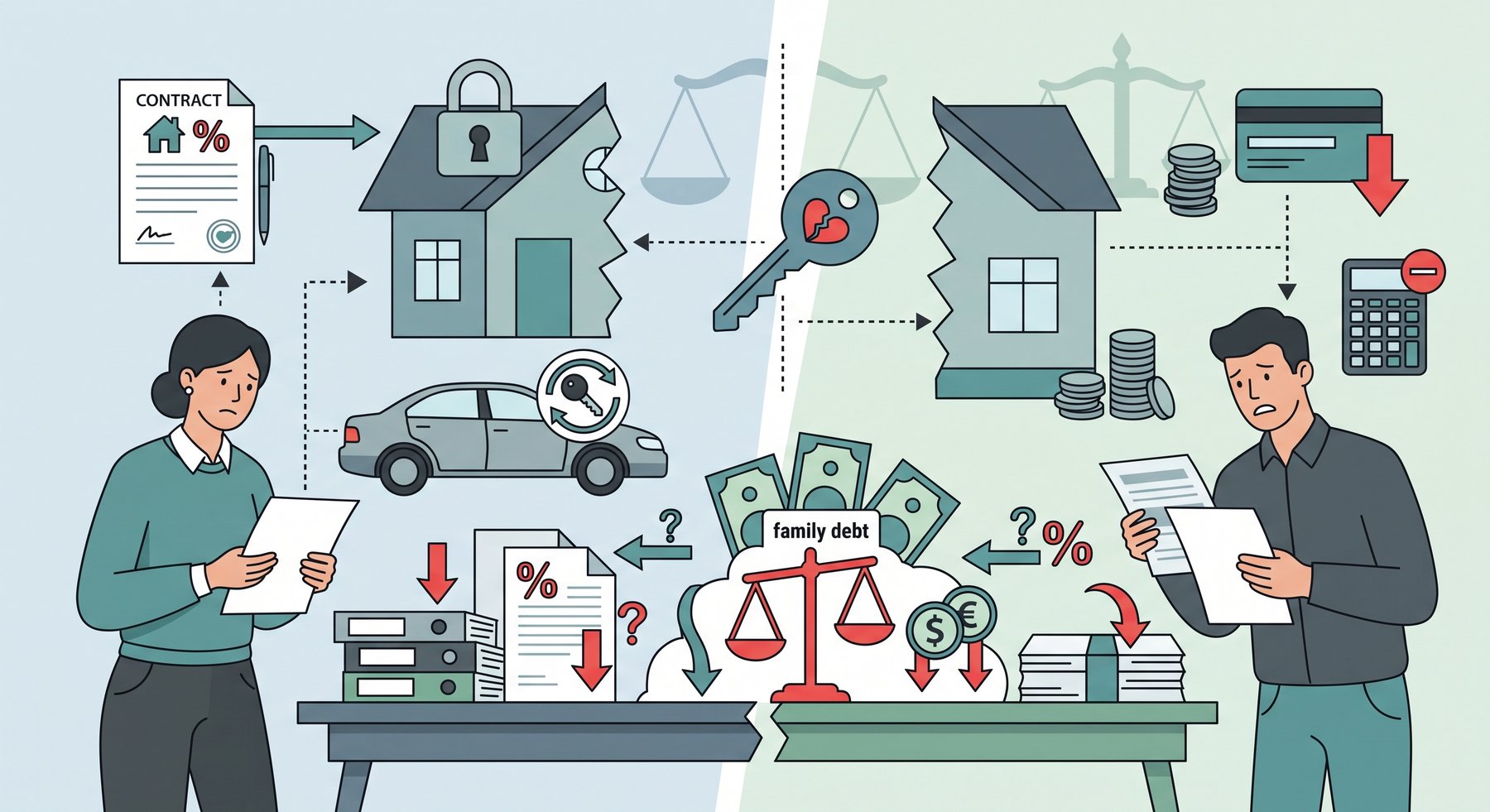

A Shijiazhuang couple divorce with a mortgaged home, a car financed through a lease, family loans from relatives and two school-age children. Each spouse argues that the other should bear most of the debt, while both want the children to remain near their current school. A transition period can preserve school stability while refinancing or sale is attempted, but the agreement should state clearly that interim possession does not itself decide ownership. The legal analysis keeps marital debt, mortgage rights and financing-lease obligations distinct while protecting the children’s housing stability.
The first useful step is to identify the creditor, contract and asset attached to each obligation. The first useful step is to identify the creditor, contract and asset attached to each obligation. Home mortgage, vehicle finance, relative loans and ordinary household liabilities need separate proof. Mortgage debt, family borrowing and a financing lease should not be combined merely because the same spouses make the payments. The most useful supporting records here are family transfer records, financing-lease terms and mortgage contracts. [1][2]
The specific problem
The Legal Rule
The first useful step is to identify the creditor, contract and asset attached to each obligation.
The Business Impact
Gather the marriage, identity, asset, income and child-related records that determine jurisdiction and relief before filing or negotiating. Cross-border facts can change both the available order and whether it will be practical to enforce. Apply that to the facts of A Shijiazhuang Divorce with a Mortgaged Home and Family Debt: Ownership, Joint Liabilities, Custody and Enforcement.
List each asset and debt before applying a joint-debt label
The financing-lease contract is particularly important because the family may use the vehicle without owning it outright. A divorce allocation can rearrange responsibility between spouses without changing a lender’s or lessor’s external rights. That makes the family order workable against the contracts that remain in force after divorce. The section should close with a path to ending the joint financial relationship, not merely assigning monthly payments. Applied to “List each asset and debt before applying a joint-debt label,” that produces a section-specific recommendation rather than a reusable evidence checklist. For list each asset and debt before applying a joint-debt label, the debt chart should name the creditor, contractual debtor and step required to end external liability after the family allocation.
The family home requires both ownership and mortgage analysis
A mortgage, a relative’s loan and a financing lease cannot be analyzed as though they were the same debt. The first useful step is to identify the creditor, contract and asset attached to each obligation. Title, contribution, outstanding debt and lender rights should be mapped. Mortgage debt, family borrowing and a financing lease should not be combined merely because the same spouses make the payments. The most useful supporting records here are vehicle payment history, financing-lease terms and mortgage contracts. [1][4]
Housing stability for children can be protected temporarily while the external debt and title issues are resolved on their own terms. That is why refinancing, lease transfer and creditor release belong in the implementation analysis from the beginning. Refinancing, lease transfer, termination or sale should be linked to documentary proof of release. Where children remain in the home temporarily, the property and debt exit should still have a defined trigger and documentary finish. Applied to “The family home requires both ownership and mortgage analysis,” that produces a section-specific recommendation rather than a reusable evidence checklist. For the family home requires both ownership and mortgage analysis, the debt chart should name the creditor, contractual debtor and step required to end external liability after the family allocation.
Family loans should be tested against contemporaneous evidence
The household balance sheet contains several different legal relationships, and they should remain separate. A mortgage, a relative’s loan and a financing lease cannot be analyzed as though they were the same debt. Bank transfers, repayment history and the purpose of borrowing matter. The evidence should identify the creditor and contract attached to each household obligation. The most useful supporting records here are vehicle payment history, mortgage contracts and family transfer records. [1][2]
The financing-lease contract is particularly important because the family may use the vehicle without owning it outright. That is why refinancing, lease transfer and creditor release belong in the implementation analysis from the beginning. That makes the family order workable against the contracts that remain in force after divorce. Where children remain in the home temporarily, the property and debt exit should still have a defined trigger and documentary finish. Applied to “Family loans should be tested against contemporaneous evidence,” that produces a section-specific recommendation rather than a reusable evidence checklist. For family loans should be tested against contemporaneous evidence, the debt chart should name the creditor, contractual debtor and step required to end external liability after the family allocation.
A financing lease should be read from the contract
The household balance sheet contains several different legal relationships, and they should remain separate. The first useful step is to identify the creditor, contract and asset attached to each obligation. Ownership, remaining installments and termination rights may differ from an ordinary car loan. Mortgage debt, family borrowing and a financing lease should not be combined merely because the same spouses make the payments. The most useful supporting records here are financing-lease terms, repayment messages and family transfer records. [1][3]
Housing stability for children can be protected temporarily while the external debt and title issues are resolved on their own terms. That is why refinancing, lease transfer and creditor release belong in the implementation analysis from the beginning. Refinancing, lease transfer, termination or sale should be linked to documentary proof of release. Where children remain in the home temporarily, the property and debt exit should still have a defined trigger and documentary finish. Applied to “A financing lease should be read from the contract,” that produces a section-specific recommendation rather than a reusable evidence checklist. For a financing lease should be read from the contract, the debt chart should name the creditor, contractual debtor and step required to end external liability after the family allocation.
Child housing stability can justify an interim occupancy solution
The first useful step is to identify the creditor, contract and asset attached to each obligation. A mortgage, a relative’s loan and a financing lease cannot be analyzed as though they were the same debt. Temporary use should not automatically decide final title. Mortgage debt, family borrowing and a financing lease should not be combined merely because the same spouses make the payments. The most useful supporting records here are creditor release letters, mortgage contracts and family transfer records. [1][4]
Internal allocation between spouses may affect their economic settlement without changing the rights of a bank, lessor or other creditor. That is why refinancing, lease transfer and creditor release belong in the implementation analysis from the beginning. That makes the family order workable against the contracts that remain in force after divorce. Where children remain in the home temporarily, the property and debt exit should still have a defined trigger and documentary finish. Applied to “Child housing stability can justify an interim occupancy solution,” that produces a section-specific recommendation rather than a reusable evidence checklist. For child housing stability can justify an interim occupancy solution, the debt chart should name the creditor, contractual debtor and step required to end external liability after the family allocation.
Debt allocation between spouses does not automatically bind creditors
The household balance sheet contains several different legal relationships, and they should remain separate. A mortgage, a relative’s loan and a financing lease cannot be analyzed as though they were the same debt. Internal family allocation and external creditor rights must be distinguished. Mortgage debt, family borrowing and a financing lease should not be combined merely because the same spouses make the payments. The most useful supporting records here are family transfer records, repayment messages and vehicle payment history. [1][2]
Housing stability for children can be protected temporarily while the external debt and title issues are resolved on their own terms. That is why refinancing, lease transfer and creditor release belong in the implementation analysis from the beginning. That makes the family order workable against the contracts that remain in force after divorce. Where children remain in the home temporarily, the property and debt exit should still have a defined trigger and documentary finish. Applied to “Debt allocation between spouses does not automatically bind creditors,” that produces a section-specific recommendation rather than a reusable evidence checklist. For debt allocation between spouses does not automatically bind creditors, the debt chart should name the creditor, contractual debtor and step required to end external liability after the family allocation.
Support calculations should separate debt service from child expenses
A mortgage, a relative’s loan and a financing lease cannot be analyzed as though they were the same debt. A mortgage, a relative’s loan and a financing lease cannot be analyzed as though they were the same debt. Mortgage and vehicle payments are not the same as ordinary support. Mortgage debt, family borrowing and a financing lease should not be combined merely because the same spouses make the payments. The most useful supporting records here are family transfer records, creditor release letters and vehicle payment history. [1][2]
Internal allocation between spouses may affect their economic settlement without changing the rights of a bank, lessor or other creditor. A divorce allocation can rearrange responsibility between spouses without changing a lender’s or lessor’s external rights. That makes the family order workable against the contracts that remain in force after divorce. Where children remain in the home temporarily, the property and debt exit should still have a defined trigger and documentary finish. Applied to “Support calculations should separate debt service from child expenses,” that produces a section-specific recommendation rather than a reusable evidence checklist.
A buyout needs refinancing and evidence of creditor release
A mortgage, a relative’s loan and a financing lease cannot be analyzed as though they were the same debt. The household balance sheet contains several different legal relationships, and they should remain separate. The spouses should know when external liability really ends. The evidence should identify the creditor and contract attached to each household obligation. The most useful supporting records here are family transfer records, financing-lease terms and vehicle payment history. [1][2]
The financing-lease contract is particularly important because the family may use the vehicle without owning it outright. That is why refinancing, lease transfer and creditor release belong in the implementation analysis from the beginning. Refinancing, lease transfer, termination or sale should be linked to documentary proof of release. The section should close with a path to ending the joint financial relationship, not merely assigning monthly payments. Applied to “A buyout needs refinancing and evidence of creditor release,” that produces a section-specific recommendation rather than a reusable evidence checklist. The settlement should state whether a buyout needs refinancing and evidence of creditor release requires lender or lessor consent and what happens if that consent is refused.
Final settlement should reduce future financial entanglement
The household balance sheet contains several different legal relationships, and they should remain separate. The household balance sheet contains several different legal relationships, and they should remain separate. Clear payment, registration and possession terms help prevent repeat litigation. Mortgage debt, family borrowing and a financing lease should not be combined merely because the same spouses make the payments. The most useful supporting records here are financing-lease terms, family transfer records and vehicle payment history. [1][4]
Housing stability for children can be protected temporarily while the external debt and title issues are resolved on their own terms. A divorce allocation can rearrange responsibility between spouses without changing a lender’s or lessor’s external rights. That makes the family order workable against the contracts that remain in force after divorce. Where children remain in the home temporarily, the property and debt exit should still have a defined trigger and documentary finish. Applied to “Final settlement should reduce future financial entanglement,” that produces a section-specific recommendation rather than a reusable evidence checklist. The settlement should state whether final settlement should reduce future financial entanglement requires lender or lessor consent and what happens if that consent is refused.
Financing-lease obligations require their own contract analysis
The Civil Code treats financing leases as a distinct contractual arrangement. The lessor typically acquires the asset selected by the lessee, the lessee pays rent, and the contract addresses matters such as term, rent and end-of-term ownership. The Supreme People’s Court interpretation also directs courts to examine the substance of the transaction when deciding whether the relationship is truly a financing lease. [1][3]
For a family vehicle, this means the divorce should not assume that the spouses own an asset equal to the vehicle’s market value minus a loan balance. The lessor may retain ownership, and the lessee may hold contractual use and eventual ownership rights subject to the agreement. Counsel should review remaining rent, transfer restrictions, termination rights and end-of-term treatment. If one spouse wants to keep using the vehicle, lessor consent may be necessary.
The marital settlement can allocate the economic burden between spouses, but it should not pretend to bind the lessor. A transfer, novation, payoff or termination mechanism may be needed. If none is available, the parties should decide who remains the contractual lessee and how the other spouse is protected from future payments or use. Treating the financing lease separately from the mortgage and family loans makes the overall debt plan much clearer. The settlement should also address insurance, registration and maintenance for the vehicle until the financing lease is transferred or terminated.
Joint-debt analysis and creditor rights should be shown on two different columns
Family cases often speak of “allocating debt” as though one decision answers both the spouses and the creditor. It does not. The Civil Code and the Supreme People’s Court rules on spousal debt address when an obligation is treated as a joint marital debt, while the mortgage lender, financing lessor or relative may have contractual rights against a particular borrower or guarantor. A useful case schedule should therefore show the internal family classification in one column and the external creditor position in another. [1][2]
This is particularly important for the family home. If both spouses signed the mortgage, an agreement that one spouse will “take the loan” does not itself release the other. The same is true of a financing lease whose contractual lessee remains unchanged. The settlement should identify the step required to obtain release, whether refinancing, lessor consent, payoff or sale, and the date by which it must occur.
Where release cannot be achieved immediately, the parties need interim protection. Indemnity, payment monitoring, insurance requirements or a scheduled sale may be appropriate depending on the risk. These are contractual risk-control tools rather than automatic family-law consequences. Their purpose is to prevent a divorce judgment from appearing to end joint liability while the outside creditor can still enforce the original contract months or years later.
The same two-column approach can be used for family loans. The spouses may agree internally that one will reimburse the other, while the relative creditor may continue to pursue whichever person actually borrowed or promised repayment. The settlement should state whether the family creditor has released anyone or whether the internal allocation is only between the spouses.
Case study: applying the framework
Assume the home is jointly registered with a RMB 1.4 million mortgage, one spouse remains there with the children, the family owes RMB 500,000 to a sibling under an unsigned repayment schedule, and the family car is held under a financing lease with eighteen payments remaining.
The sibling loan requires proof beyond the fact that money entered the household. The spouses should identify when it was transferred, what it funded and whether repayments occurred before divorce. If the debt financed the family home, the marital-liability analysis may differ from a loan used for one spouse’s separate activity. The financing lease on the car also needs its own contract review because legal title may remain with the lessor until the final payment. A settlement could keep the children in the home temporarily while one spouse seeks refinancing, then trigger sale if the bank refuses release. The agreement should say separately who services the mortgage and vehicle obligations during that transition.
The sibling loan should be placed in the same balance sheet as the mortgage but not assumed to have the same legal status. If the family home is sold, the agreement should specify whether any disputed family debt is paid from sale proceeds or reserved for later determination. The vehicle lease should include a transfer or termination plan so one spouse is not left paying for a car used by the other. These practical terms can reduce post-divorce enforcement disputes significantly. The spouses would also define who maintains insurance and registration on the vehicle until the lease is transferred or terminated. If the financing lessor refuses a transfer to the spouse who will keep the car, the settlement should provide for payoff, return or another vehicle arrangement. The family should not be left with an order assigning the car to someone who cannot become the contractual lessee. Any interim occupancy order should state who maintains property insurance and who receives notices from the mortgage lender while refinancing or sale remains pending. The spouses should also identify who receives any vehicle deposit or residual value if the financing lease is terminated before the final payment. Any such residual value should be evidenced by the lessor’s final statement.
Conclusion
A divorce involving a mortgage, family borrowing and a financing lease should end with a plan for each creditor relationship. Marital allocation between spouses does not rewrite the bank’s or lessor’s contract. The Civil Code’s financing-lease rules also mean that use of a vehicle may not equal ownership. A durable settlement protects the children’s short-term housing stability while setting clear triggers for refinancing, lease transfer, termination or sale and documenting when joint financial exposure has actually ended.
Legal and regulatory sources
[1] Civil Code of the People’s Republic of China — [official source](https://www.court.gov.cn/zixun/xiangqing/233181.html) [2] SPC Interpretation on Disputes Concerning Spousal Debts — [official source](https://www.court.gov.cn/fabu/xiangqing/77352.html) [3] SPC Interpretation on Financing Lease Contract Disputes — [official source](https://gongbao.court.gov.cn/Details/92e70f51d47a4dcb7f2dd7ad214df2.html) [4] Civil Procedure Law of the People’s Republic of China — [official source](https://cicc.court.gov.cn/html/1/218/62/83/443.html)
General legal information only; not legal advice for a specific matter.
Discussion
Share experience or questions about this topic. This is a public discussion — not legal advice. Do not post confidential case details.
Have a question after reading? Leave it here, or Ask a Lawyer for a free initial intake.
Comments are moderated. China Legal Portal is a directory and information resource; no attorney–client relationship is formed by posting here.