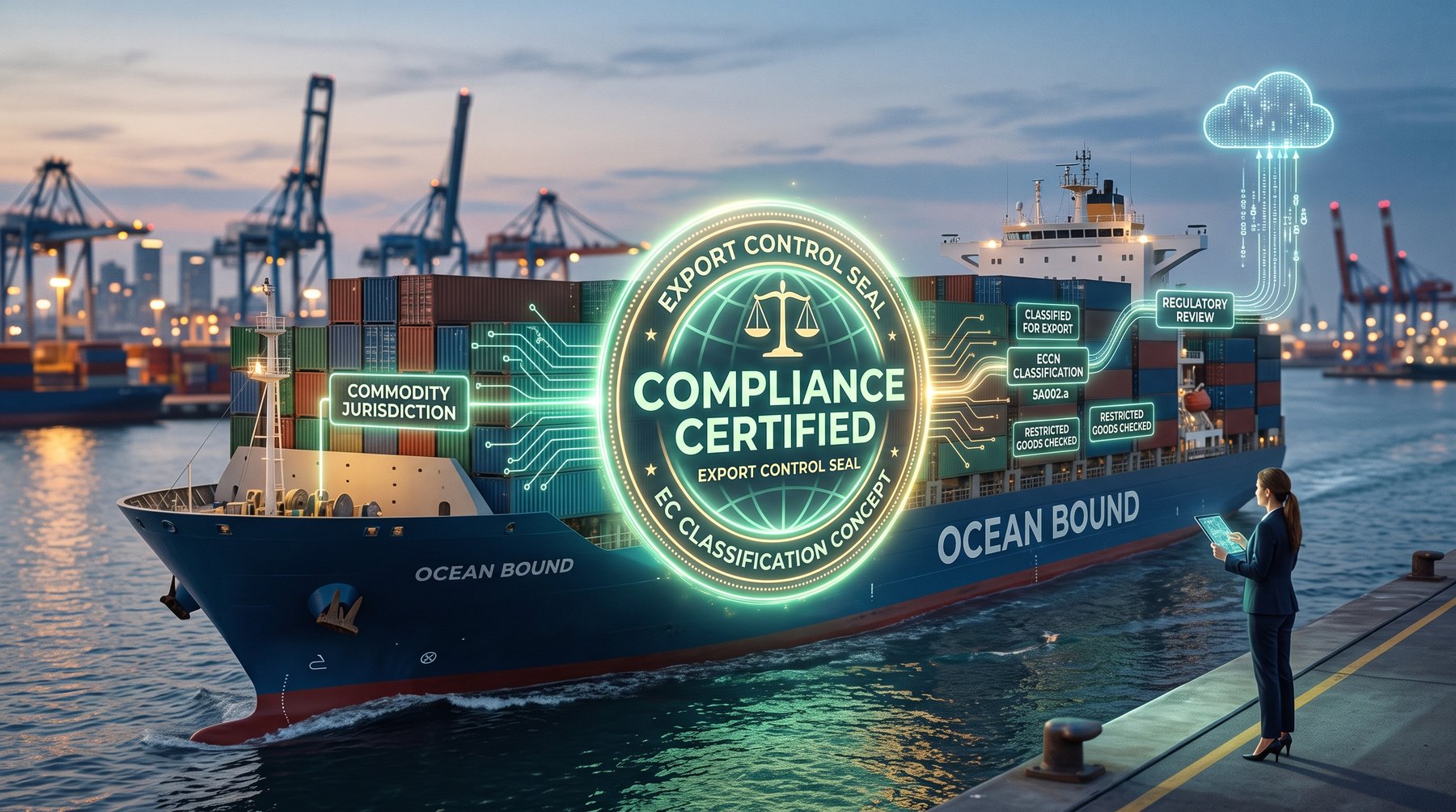

A Chinese manufacturer approves an overseas factory, signs construction milestones and orders production equipment. Only after project commitments are fixed does the compliance team discover that one testing system and some technical data may fall within China's dual-use export-control regime. The legal challenge is therefore not generic outbound investment compliance. It is how to make export-control classification, end-user review, end-use restrictions and licensing part of the investment approval, procurement and financing process before the project timetable becomes impossible to change.
China's Export Control Law applies to controlled goods, technologies and services and expressly includes related technical materials and data. Articles 12 through 16 address licensing, end-user and end-use controls. The Regulations on Export Control of Dual-Use Items, effective December 1, 2024, operationalize the dual-use system. NDRC's outbound investment rules regulate enterprise overseas investment separately, so an ODI filing or approval does not authorize the export of controlled equipment or technology.
The specific issue
The Legal Rule
China's Export Control Law applies to controlled goods, technologies and services and expressly includes related technical materials and data.
The Business Impact
Use “Outbound Manufacturing Compliance: Embedding Export-Control Classification and End-Use…” to set the compliance steps before the goods move, not after they reach the border. Confirm the declarant, permits, valuation basis and supporting evidence early enough to fix gaps without disrupting delivery.
1. Separate the capital-investment map from the controlled-item and technology map
Maintain two parallel maps for every outbound manufacturing project: a capital-and-corporate map covering ODI filings, equity, financing and land, and a controlled-item-and-technology map covering equipment, software, drawings, process data and remote support. An ODI approval does not authorize export of controlled items. Confusing the two maps is how projects become contractually committed before licensing risk is understood.
2. Classify critical machinery before signing fixed construction or customer deadlines
Classify critical machinery using engineering data—model numbers, performance parameters, software functions and intended use—before the company signs fixed EPC milestones or customer delivery dates. Supplier assurances that a machine is “commercial” are not a classification. If parameters are incomplete, treat the item as unresolved and keep it off the unconditional project critical path.
3. Include software, technical drawings, source code and remote support in the transfer inventory
Inventory software, firmware, source code, process recipes, technical drawings and remote-diagnostic access alongside physical goods. China’s Export Control Law reaches related technical materials and data. A project that licenses only the hardware while engineers push uncontrolled updates and drawings to the overseas plant has not actually controlled the transfer.
4. Treat a wholly owned overseas subsidiary as an overseas recipient for control analysis
Analyze the wholly owned overseas subsidiary as an overseas recipient, not as an internal warehouse. Equity control does not erase export-control analysis. End-user and end-use documents, license conditions and retransfer limits still apply when equipment and technical data move from the Chinese parent to the foreign subsidiary.
5. Define end user and end use before license applications are prepared
Define the legal recipient and the operational end user before preparing license applications. A subsidiary, joint-venture plant, contract manufacturer and downstream customer are different end-use stories. If the business expects later relocation, multi-site use or third-party processing, those scenarios must be disclosed and assessed before end-user statements are signed.
6. Align JV and subcontractor access rights with approved end-use restrictions
Align JV partner and subcontractor access with approved end-use restrictions. If uncontrolled personnel can operate, copy or reverse-engineer controlled equipment or data, the company’s license narrative is incomplete. Contractual access limits, badge controls and technical compartmentalization should match what was represented to the licensing authority.
7. Draft licensing conditions and regulatory-delay allocation into EPC and supply contracts
Draft EPC, equipment-supply and customer contracts so export licensing is a defined dependency: who supplies technical data, whether license grant is a condition precedent, how delay is allocated and what happens if a critical license is denied. Without that drafting, a regulatory pause becomes an unallocated liquidated-damages and default problem.
8. Re-screen items when design, procurement or shipment timing changes
Re-screen classification and licensing when design, bill of materials, software load or shipment timing changes. A machine cleared under one configuration may be controlled after a performance upgrade or bundled process package. Procurement change orders should trigger compliance review, not only price and lead-time review.
9. Map export-control dependencies into bank financing and drawdown conditions
Map license and classification dependencies into facility agreements and drawdown conditions. Lenders that fund against installed capacity or commissioning dates need to know if a controlled machine can lawfully ship. Otherwise a compliance delay becomes a financing default even when the company is acting diligently.
10. Assign internal ownership for classification, screening, licensing and escalation
Assign named owners for classification, customer/end-use screening, license preparation, shipping release and escalation to the board. A policy that says “the company complies with export control” without role clarity fails under time pressure, when procurement and project teams push to keep the schedule.
11. Require vendors to provide technical parameters sufficient for classification
Require vendors to deliver technical parameters sufficient for classification before purchase orders for sensitive machinery become unconditional. If the vendor refuses performance data, software descriptions or intended-use detail, the company cannot complete a defensible classification and should not treat the PO as schedule-critical.
12. Create a controlled-item master linked to procurement and ERP records
Create a controlled-item master linked to SKU, serial number, license status and ERP procurement records. Spare parts, replacements and later “identical” machines must inherit the same review. Without a master, the first shipment may be reviewed while the fifth bypasses compliance as a routine reorder.
13. Control remote technical support after the plant becomes operational
Control remote technical support after operations begin. Remote diagnostics, engineer VPN access and over-the-air parameter changes can transfer controlled technical data even when no physical goods leave China. Support playbooks should identify when a ticket requires export-control review before credentials are issued.
14. Preserve end-user certifications, licenses, classification files and internal approvals
Preserve end-user certifications, license documents, classification memos, internal approvals and shipping-release records for the life of the equipment’s controlled status. When authorities or banks ask why an item shipped, the company needs a file—not a recollection that engineering “thought it was fine.”
15. Include export-control analysis in the board's outbound investment paper
Include export-control conclusions in the board’s outbound investment paper alongside ODI status and project economics: which items and data transfers are critical, which are unresolved, licensing lead times and the schedule impact if a license is delayed or denied. Investment readiness is incomplete without that analysis.
16. Test the compliance system with a realistic shipment scenario
Run a realistic shipment dry run before the first controlled dispatch: classification on file, end-user documents, license conditions, ERP release flags, logistics paperwork and overseas receiving controls. The dry run should attempt to break the process—missing serial numbers, software add-ons, last-minute destination changes—so gaps appear in rehearsal rather than on the first live shipment.
17. Train the overseas subsidiary on retransfer and change-of-end-use restrictions
Train the overseas subsidiary’s management on retransfer, re-export and change-of-end-use restrictions that attach to licensed or controlled items. Local teams often treat equipment moves, line sharing with a contractor or new product use as ordinary operations. Those acts can breach license conditions unless reviewed and approved first.
18. Build a fallback equipment plan for a denied or delayed license
Build a fallback equipment and process plan if a critical license is denied or delayed: alternative non-controlled machinery, local sourcing, redesigned process steps, schedule relief rights and customer-communication protocols. A project with no fallback converts a licensing issue into an existential commissioning failure.
19. Use compliance gates before purchase orders for sensitive machinery are released
Impose a compliance gate before purchase orders for sensitive machinery are released: classification complete or expressly deferred with risk acceptance, end-use path defined, and licensing timeline compatible with contractual milestones. Procurement should not be able to create irreversible vendor commitments that outrun the regulatory path.
20. Do not mark the project investment-ready until item and technology transfer risks are documented
Do not mark the project investment-ready until the company can document item and technology transfer risks, owners, license strategy and contractual allocation of regulatory delay. If those elements are still “to be confirmed,” the investment decision is incomplete regardless of land, financing and customer enthusiasm.
Worked scenario: when one controlled machine threatens an entire overseas project
Assume a Chinese battery-equipment manufacturer has approved a Southeast Asian plant. The land agreement requires construction to start within ninety days and production within twelve months. The EPC contract contains delay damages. A major customer has already committed to buy locally produced output beginning in month thirteen. The production line includes a high-performance testing system, proprietary control software and remote diagnostics supplied from China.
Before the EPC contract was signed, no one performed a complete export-control classification. Engineering assumed that because the equipment is commercially sold, no license would be required. After procurement begins, compliance asks for technical parameters and finds that one testing module may fall within a dual-use control category. The remote diagnostic package also transfers technical data from China to the overseas subsidiary.
At that point the legal issue has spread beyond export control. If the machine cannot ship on time, the EPC contractor may miss commissioning, the customer may claim delay, the lender may refuse a drawdown tied to installed capacity and the host-government incentive may be at risk. A classification problem has become a project-finance and contract problem.
A better process would have created a “regulatory critical path” before final investment approval. Engineering would identify every critical item and data transfer. Compliance would classify them, record uncertainty and identify end-user/end-use information needed for licensing. Procurement would not release a purchase order for a sensitive item until the compliance status was known. The EPC and customer contracts would expressly allocate regulatory delay and allow schedule adjustment if a required Chinese export license were denied or delayed despite compliant efforts.
The overseas subsidiary also needs post-shipment controls. If the line may later be moved to another country, shared with a contract manufacturer or used for a new product, the business should not treat that as an ordinary internal asset decision. The end-use and retransfer conditions should be checked first. Remote engineering access should likewise be governed by a support procedure that identifies whether controlled technical data will be provided.
This example shows why enterprise compliance must sit inside investment governance. The board paper should show not only ODI status and project economics but also whether the company can lawfully move the equipment and technology required to make the overseas investment operational.
Action checklist before implementation
- Confirm who has authority to approve outbound investment readiness including export-control gates.
- Assemble the core evidence set: equipment master list, technical specifications, software and data inventory, classification records, end-user documents, ODI filings, EPC and finance contracts, purchase orders and license files.
- Identify the one regulatory fact that could make the preferred shipment plan unavailable and verify it first.
- Quantify schedule and liquidated-damages exposure if a critical license is delayed.
- List third parties whose information is required—vendors, JV partners, banks and the overseas subsidiary.
- Define the fallback equipment or process plan if a license is denied.
- Reconcile project milestones with licensing lead times before signing unconditional dates.
- Assign owners for classification, screening, licensing and shipping release.
- Ensure board papers and customer commitments do not assume unlawful transfer.
- Retain a completion file for each controlled shipment release.
Quality-control questions
Before the matter is closed, an independent reviewer should be able to reconstruct the classification status of critical items and data transfers, the license strategy and the contractual allocation of regulatory delay. The reviewer should explain why the team avoided treating export control as a shipment-stage customs task after construction and customer obligations had already become unconditional. If that explanation depends on recollection rather than the file, the work is not complete.
Decision tree for outbound project approval
The investment committee should require a classification status for every item whose absence would stop the project from reaching commercial operation. Items can be grouped as cleared, potentially controlled, controlled with an identified license route, or unresolved. An unresolved critical item should be treated like an unresolved land title or financing condition: the board may still approve development work, but it should not approve an unconditional timetable that assumes exportability.
The project team should then identify the legal recipient and end user for each sensitive item. A wholly owned foreign subsidiary may be the importer, but a contract manufacturer, JV partner or customer may operate the equipment. If the business model anticipates shared use or later relocation, those possibilities should be disclosed to compliance before end-use documentation is finalized.
The third gate is contract alignment. The EPC contract, equipment purchase agreement, customer supply agreement and finance documents should not contain incompatible assumptions. If commissioning depends on a Chinese export license, the EPC schedule should include the licensing dependency. If the customer contract has delay damages, management should know whether regulatory delay is excused. If a lender requires installed equipment before drawdown, financing contingency should be modeled.
Finally, the company should decide which compliance controls continue after shipment. Spare parts, software updates, remote diagnostics, engineer travel and technology transfer can all create later export-control questions. The overseas subsidiary should not be allowed to alter end use or retransfer equipment without a defined review.
Technical and compliance file
The classification file should include supplier technical specifications, model numbers, performance parameters, software functions, technical drawings where needed, the internal classification analysis and any regulator-facing material. The file should explain why the item was considered outside or inside a control category rather than simply record the final answer.
For controlled items, the company should retain the license application, end-user and end-use certification, approval, conditions, shipment records and evidence that the overseas user received relevant restrictions. Where a license is not required, the business should still preserve the classification basis for critical items so the decision can be defended later.
The technology-transfer file should separately identify source code, firmware, process recipes, maintenance manuals, remote-access tools and technical support. Physical shipment controls do not automatically cover those transfers. Engineering should know which technical questions require legal review before information is sent overseas.
The board should receive periodic exception reporting. It does not need every product classification, but it should be told when a project-critical item remains unresolved, a license condition conflicts with the operating model, or the overseas subsidiary requests a retransfer. That is how export control becomes part of governance rather than a shipment-day formality.
Contract drafting points that should be fixed before project commitment
The equipment purchase agreement should require the supplier to provide technical information sufficient for classification and to notify the buyer if specifications change. If the supplier itself has export-control classifications from another jurisdiction, those materials may be useful background but should not replace the Chinese analysis. The buyer should reserve the right to delay shipment or terminate a purchase where a required Chinese license cannot lawfully be obtained.
The EPC contract should distinguish ordinary contractor delay from regulatory delay affecting owner-supplied equipment. If a critical item cannot be exported, the parties should know whether the commissioning date extends automatically, whether substitute equipment can be used and who bears redesign cost. A force-majeure clause drafted for earthquakes or war may not address a foreseeable licensing dependency with enough precision.
Customer supply agreements should likewise avoid absolute commitments where production depends on unresolved regulatory approvals. The manufacturer can commit to a target launch date while expressly addressing the effect of denied or delayed approvals that are outside its control. This is not an excuse to delay compliance work; it is a way to align contractual liability with a known regulatory dependency.
The financing documents should be reviewed for representations that the project has obtained all necessary approvals and can lawfully acquire and export all equipment. Those statements should not be made before the classification work is complete. A compliance conclusion should therefore be part of financing sign-off, not a separate memo held by the export team.
Conclusion
This issue should be managed as a specific legal-control problem. The legal framework must be applied to verified facts and converted into an executable sequence. The central lesson from this scenario is to avoid treating export control as a shipment-stage customs task after construction and customer obligations have already become unconditional. A strong file shows the legal rule, the commercial decision, the supporting evidence and the fallback if the preferred route fails.
Legal and regulatory sources
[1] Export Control Law of the PRC: https://www.npc.gov.cn/englishnpc/c2759/c23934/202112/t20211209_384804.html [2] Regulations on Export Control of Dual-Use Items: https://exportcontrol.mofcom.gov.cn/article/zcfg/gnzcfg/gzjgfxwj/202410/1057.html [3] NDRC Administrative Measures for Enterprise Overseas Investment: https://zfxxgk.ndrc.gov.cn/web/iteminfo.jsp?id=18522
This article is general legal information and is not legal advice for a specific matter.
Discussion
Share experience or questions about this topic. This is a public discussion — not legal advice. Do not post confidential case details.
Have a question after reading? Leave it here, or Ask a Lawyer for a free initial intake.
Comments are moderated. China Legal Portal is a directory and information resource; no attorney–client relationship is formed by posting here.