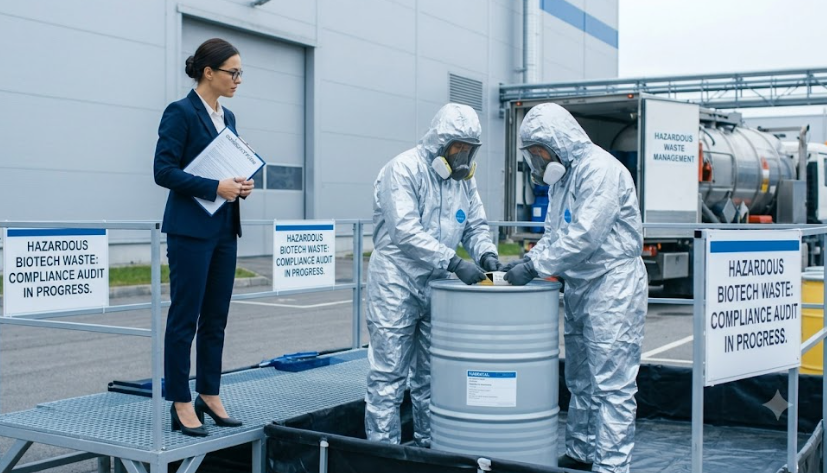

Raid kits fail when only lawyers know they exist. Sales leadership must rehearse the first hour. This article gives pharmaceutical and medical device companies a practical, legally grounded operating procedure for the moment Chinese enforcement officials arrive unannounced at a sales or medical affairs office, with the statutory provisions that support each step and the enforcement cases that show what goes wrong when teams improvise.
Why the first hour decides the investigation
The Legal Rule
Life-sciences obligations depend on the product, activity, approval status and regulatory role of each party. Quality, promotion, trial, distribution and safety duties should be allocated and documented before performance.
The Business Impact
Map the product, claims, distribution model and responsible entity to the relevant approval, quality and promotional controls before launch. Small commercial changes can shift which compliance obligations apply. Apply that to the facts of One-Page Dawn Raid Card for Pharma Sales & Medical Affairs Teams.
Chinese market regulation authorities, public security organs and anti-corruption agencies all have the power to conduct unannounced inspections of pharmaceutical companies. When they arrive, the first sixty minutes typically determine what evidence becomes part of the file, how witnesses describe the events later, and whether the company is treated as cooperative or obstructive. Commercial teams that have never rehearsed this moment make predictable mistakes: employees answer questions they should not answer, laptops are closed or wiped, WeChat messages are deleted, and documents that would have been harmless are destroyed in a panic. Each of these actions creates a separate legal problem that can be harder to resolve than the underlying investigation.
This article focuses on the sales and medical affairs context, where the risk is highest. A pharmaceutical representative's phone, laptop and WeChat history are usually the most valuable evidence in a bribery investigation. The golden first hour is the only period in which the company can still impose order on how that evidence is handled and how employees speak to investigators. After that hour, positions harden and the narrative belongs to the enforcement agency.
Statutory framework for unannounced inspections
The legal basis for market regulation inspections in the pharmaceutical sector sits primarily in three statutes. Understanding them is not an academic exercise; each provision maps to a concrete step on the one-page card recommended below.
Anti-Unfair Competition Law
The PRC Anti-Unfair Competition Law (AUCL), last amended in 2019, gives market regulation authorities broad investigative powers in commercial bribery cases. Article 12 authorizes the authority to enter the business premises of the party under investigation and to inspect the relevant premises and articles. Article 13 permits the authority to seal or seize the property, documents and data related to the suspected illegal acts. Article 28 establishes penalties of up to RMB 500,000 for refusing, obstructing or delaying an investigation, or for forging, hiding or destroying relevant evidence. These three articles form the statutory core of every dawn raid in the pharmaceutical sector, and they explain why the company's operational goal is cooperation on process, not resistance to inspection.

- Why the first hour decides the investigation. Dawn raids succeed or fail in the first hour — field teams need a one-page legal protocol, not a binder.
- Identity of officials; scope of warrant/notice
- Call legal immediately
"Article 13 of the PRC Anti-Unfair Competition Law: Where the authority investigating suspected acts of unfair competition conducts an investigation, it may ... seal or seize the relevant property, documents and data related to the suspected illegal acts, and make an inventory thereof."
Administrative Penalty Law
The PRC Administrative Penalty Law, as revised in 2021, protects the investigated party during the enforcement process. Article 47 requires enforcement officers to show their law enforcement credentials when conducting investigations or inspections. Article 49 requires that evidence collection be lawful and that evidence obtained by illegal means cannot be used as the basis for an administrative penalty. Article 55 gives the party the right to make statements and present a defense before the penalty decision is issued, and requires the authority to state the facts, reasons and basis of the penalty in the written decision. These provisions support the two most important instructions on the dawn raid card: verify credentials before allowing access, and never sign or agree to anything during the inspection itself.
Criminal Law
The PRC Criminal Law Article 277 establishes the crime of obstructing official duties, which carries penalties including criminal detention for persons who use violence or threats to obstruct state organ personnel from performing their statutory duties. In the pharmaceutical context, this provision matters because the instinct to physically block inspectors, hide evidence or threaten witnesses can escalate an administrative investigation into a criminal matter. The line between administrative obstruction and criminal obstruction is thin, and a panicked sales manager can cross it in seconds.
Enforcement cases that define the rules of engagement
Two cases are particularly instructive for foreign pharmaceutical companies operating in China.
GSK China commercial bribery case
The GlaxoSmithKline China case, resolved by the Changsha Intermediate People's Court in 2014, remains the defining precedent on corporate criminal liability for sales team misconduct. The court imposed fines and penalties on the company and its senior executives for systematic bribery of physicians and hospitals through travel, hospitality and consulting fees disguised as legitimate expenses. The case established that a company cannot distance itself from field-level misconduct by claiming the representatives acted without authorization, and that dual-penalty enforcement, against both the entity and the individuals, is the normal pattern in serious pharmaceutical bribery cases. For in-house counsel, the lesson is that the dawn raid card is not merely a compliance document; it is a component of the company's defense that the sales function was supervised, trained and controlled.
Shanghai AMR deletion case
In an administrative penalty issued by the Shanghai Administration for Market Regulation in 2021, a foreign pharmaceutical distributor was penalized after employees deleted local server communications during an unannounced inspection. The enforcement authority treated the deletion as evidence of consciousness of wrongdoing and used it to support the penalty calculation. The case demonstrates that the instinct to delete, tidy or re-image during an inspection is not only ineffective but affirmatively harmful. The company's own evidence-preservation obligations, including any requirement to retain records for regulatory or tax purposes, are also undermined by ad hoc deletion during an active investigation.
The golden one-hour dawn raid card
The practical deliverable is a one-page card that every sales and medical affairs employee can keep on their desk or phone. It has four sections, each mapped to the statutory framework above.
Step 1: Verify and record (minutes 0-5)
Ask to see the credentials of every officer present, and record the names, badge numbers and agency of each. The AUCL Article 47 credential requirement gives the company the right to verify before cooperating. This is not obstruction; it is procedure. One employee, normally the most senior person present, becomes the designated liaison. Everyone else is instructed to remain calm, not to volunteer information, and to wait for the liaison to speak for the company.
Step 2: Assert process rights (minutes 5-15)
The liaison states, in a prepared script, that the company will cooperate fully, that counsel has been notified, and that the company requests a duplicate sealing of any computers or hard drives that are to be seized. The AUCL Article 13 sealing power allows the authority to seize property, but the company may request an inventory and a duplicate seal so that it can later verify the integrity of the evidence. The script also includes the sentence that no employee will make statements about legal advice, and that any legal advice communications are privileged.
Step 3: Control the evidence flow (minutes 15-45)
No employee deletes messages, closes laptops by force, or moves documents. The liaison asks the inspectors which specific items they wish to examine and keeps a log of every item taken. If the inspectors request access to WeChat or local servers, the company requests that the request be documented in writing and that the extraction be performed in the presence of a company witness. The purpose is not to obstruct but to create a contemporaneous record that the company can use in its own defense later.
Step 4: Route through counsel (minutes 45-60)
By the end of the first hour, counsel should have been reached, the evidence log should be complete, and the company should have a preliminary understanding of the scope of the investigation. The liaison reminds all employees that they are not to discuss the investigation among themselves on unsecured channels, and that any questions from the media or from business partners are routed to the legal department. The final item on the card is the compliance hotline number and the instruction to call it if any employee feels pressured to answer questions they do not understand.

- Receive entry
- Verify ID and legal basis
- Notify legal/compliance
- On the one-page card numbers
- Hold & escort
Training and rehearsal
A card that sits in a drawer is worthless. Pharmaceutical companies should run a tabletop drill at least twice a year, with the sales director, medical affairs head, HR lead and legal counsel all participating. The drill should simulate a realistic scenario: two inspectors arrive at 9 am, ask for the marketing department, and request access to the WeChat records of three named representatives. Each participant should be required to perform their role from the card, and the drill should be followed by a debrief that identifies gaps. Companies that rehearse consistently find that their employees remain calmer, the evidence log is more complete, and the enforcement authority treats the company as a professional counterpart rather than a target.
Incentive structures matter as much as the card. If representatives are rewarded for volume regardless of compliance, no amount of training will prevent the behaviors that attract investigations in the first place. The dawn raid card is a response tool, not a prevention tool. Prevention requires the full compliance program: approved materials, monitored interactions, documented training and a culture in which saying no to improper requests is rewarded rather than punished.
Common mistakes and how to avoid them
The most common mistakes in the first hour, based on observed enforcement practice, are answering questions beyond one's knowledge, destroying evidence, and making promises to investigators that the company cannot keep. Employees should be trained to say, in Chinese and English, "I am not authorized to answer that question. I will route it to our designated liaison." This single sentence, repeated calmly, resolves most of the risk. The second most common mistake is treating the inspection as a negotiation. It is not. The company cooperates with the process while preserving its legal rights; it does not bargain over which documents exist. The third mistake is allowing employees to contact each other on WeChat during the inspection. Messages sent during an active investigation are frequently examined, and casual comments about the inspectors become evidence.
Finally, companies should remember that the dawn raid card is a living document. Every enforcement case, every regulatory change and every internal near-miss should trigger a review of the card and the training. The AUCL, the Administrative Penalty Law and the Criminal Law all evolve, and the card must evolve with them.
Read next: Dawn raid & anti-corruption playbook · Pharma advertising
Discussion
Share experience or questions about this topic. This is a public discussion — not legal advice. Do not post confidential case details.
Have a question after reading? Leave it here, or Ask a Lawyer for a free initial intake.
Comments are moderated. China Legal Portal is a directory and information resource; no attorney–client relationship is formed by posting here.