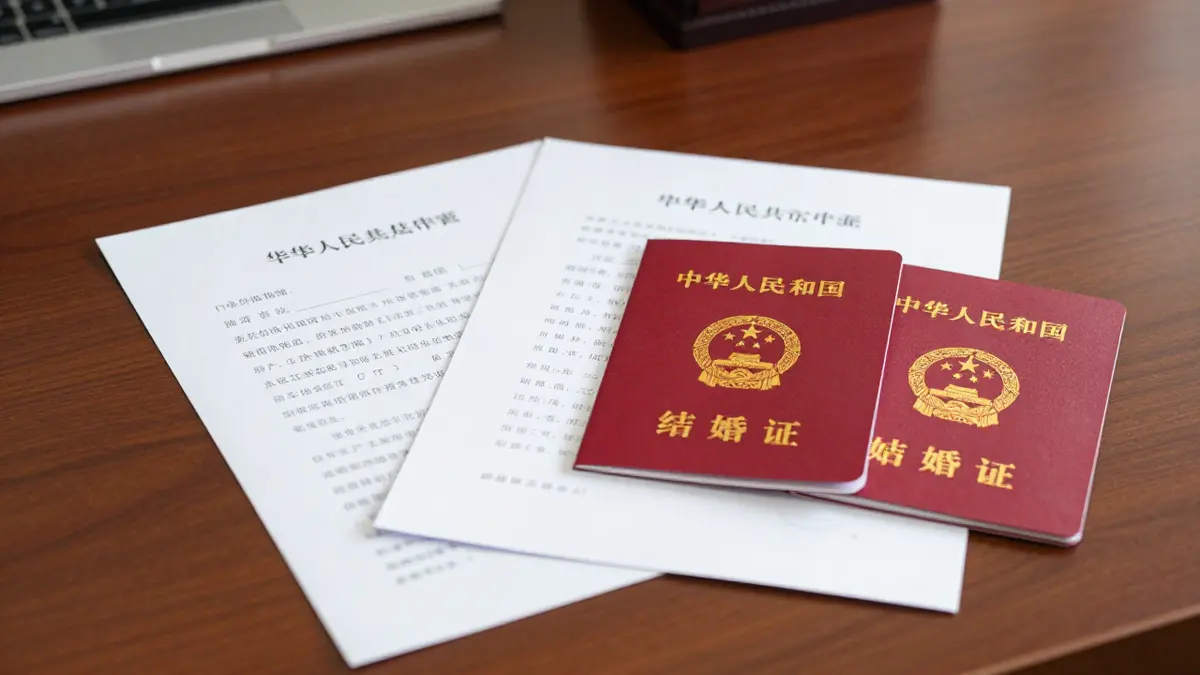

Cross-strait marriages between Mainland China and Taiwan residents are increasingly common in today's globalized world. When such marriages unfortunately end in divorce, the process involves navigating two separate legal systems with different requirements, procedures, and recognition mechanisms. This comprehensive guide explains the two pathways available for cross-strait couples — consensual divorce and contested divorce — and the specific requirements for each under Chinese and Taiwanese law.
Two Paths to Divorce: Consensual vs. Contested
The Legal Rule
Under the PRC Civil Code and the Regulations on Marriage Registration, both spouses must appear in person at the marriage registration authority where the Mainland spouse holds permanent residence.
The Business Impact
Gather the marriage, identity, asset, income and child-related records that determine jurisdiction and relief before filing or negotiating. Cross-border facts can change both the available order and whether it will be practical to enforce. Apply that to the facts of Divorce Between Mainland China and Taiwan Residents: A Complete Guide for Cross-Strait Couples.
For couples who agree on all terms of their divorce, consensual divorce ( ) offers a faster, lower-cost, and less adversarial option. Under the PRC Civil Code and the Regulations on Marriage Registration, both spouses must appear in person at the marriage registration authority where the Mainland spouse holds permanent residence. The Taiwan resident spouse does not need to return to Taiwan for this process — their Mainland Travel Permit for Taiwan Residents ( ) is sufficient identification documentation.
Both parties must sign a divorce agreement that specifies the divorce is voluntary and details arrangements for child custody and visitation, division of jointly owned property, and handling of joint debts. Under Article 1077 of the Civil Code, the 30-day cooling-off period applies: either party may withdraw their divorce application within 30 days of submission. If both still wish to proceed, they must collect the divorce certificate together in person at the registration authority during the following 30-day window. If they fail to appear, the application is deemed withdrawn.
Alternatively, the couple may handle the divorce through Taiwan's household registration system. However, a divorce registered only in Taiwan is not automatically recognized in Mainland China. When the Mainland spouse later needs to remarry or handle property transfers in Mainland China, they may need to go through a separate recognition procedure for the Taiwan divorce.
Contested Divorce: Jurisdiction and Procedure

- FAILURE MODES
- Mainland vs Taiwan competence
When the parties cannot agree on divorce terms, the case must go to court through contested divorce proceedings. Under Article 22 of the PRC Civil Procedure Law, if the Taiwan-resident defendant does not reside in Mainland China, the plaintiff may file the lawsuit at the court in their own place of domicile. If the plaintiff's domicile differs from their habitual residence, the court at the plaintiff's habitual residence has jurisdiction.
Required court documents include: the divorce complaint stating the grounds for divorce, identity documents for both parties, the original marriage certificate, children's birth certificates, and evidence of property ownership. For cross-strait cases, additional documents may include proof of the Taiwan spouse's residence status and any prior separation agreements.
Service of process is one of the most challenging aspects of cross-strait divorce litigation. Court documents must be served on the Taiwan-resident spouse through the cross-strait mutual judicial assistance mechanism, which involves coordination between the Supreme People's Court and designated Taiwanese authorities through the Straits Exchange Foundation (SEF) and the Association for Relations Across the Taiwan Straits (ARATS). This process can take several months and requires patience from both the court and the plaintiff.
Recognition of Judgments Across the Strait
A critical issue in cross-strait divorce is the cross-border recognition of court judgments. A divorce judgment issued by a Mainland Chinese court does not automatically take legal effect in Taiwan. The Taiwan party must file a separate application with a Taiwan court for recognition of the Mainland judgment under the Taiwan Compulsory Execution Act and related regulations.
Conversely, a Taiwan court's divorce judgment must be recognized by a Mainland court before it has legal effect in Mainland China. The application is governed by the Supreme People's Court's Provisions on Recognition and Enforcement of Taiwan Region Court Civil Judgments. The Mainland court reviews the Taiwan judgment for compliance with basic legal principles and public policy before issuing a recognition ruling.
Identity and marriage certificates issued in Taiwan must follow a specific verification process before they can be used as evidence in Mainland courts or administrative proceedings. The documents must first be notarized by a Taiwan notary office, then transmitted through the Straits Exchange Foundation, and finally verified by the relevant provincial notary association in Mainland China. Without this chain of verification, Taiwan-issued documents have limited evidentiary value in Mainland proceedings.
Practical Guidance for Cross-Strait Couples
Couples contemplating cross-strait divorce should carefully consider the jurisdictional and enforcement implications of their choice. Consensual divorce through Mainland marriage registration authorities is generally the simplest and most cost-effective option when both parties agree on terms. When contested divorce is unavoidable, engaging legal counsel experienced in cross-strait family law is essential to navigate the complex procedural requirements on both sides of the strait.
Property division in cross-strait divorces presents unique challenges, particularly when assets are located in both jurisdictions. Real estate can only be divided according to the law of the jurisdiction where the property is located, while movable assets may be subject to different conflict-of-law rules. Prenuptial agreements specifying the governing law for property division can significantly simplify these issues.
For child custody matters, the primary consideration under both Mainland and Taiwan law is the best interests of the child. However, enforcement of custody and visitation orders across the strait remains challenging. Courts in both jurisdictions generally prefer arrangements that minimize disruption to the child's life and maintain meaningful relationships with both parents.
Family Law Application Notes
I prefer early written notices and clean evidence indexes over informal WeChat-only chains when the amount or regulatory exposure is material.
I convert complex Chinese procedure into a dated checklist with owners for translation, notarization, and internal sign-off across time zones.
- Documented objectives and preferred remedies
- Bilingual document control
- Deadline and limitation tracking
- Enforcement and settlement options in parallel
Operational Checklist for Foreign Readers

- Divorce Between Mainland China and Taiwan Residents — process.
- Map forum and residence
- Proce…
- Plan recognition
- Complete service
I align forum and pleading choices with what can actually be enforced: assets, licenses, cash flows, and available interim measures under PRC procedure.
- Mandate letter covering scope and outcomes
- Bilingual document control
- Deadline and limitation tracking
- Enforcement and settlement options in parallel
Risk Controls Before Escalation
Strategy starts with what can be secured or collected: counterpart assets, licenses, receivables, and interim measures, then builds merits work around that path.
I document scope, assumptions, and decision rights at engagement start so foreign clients know what will be filed, who must approve, and when silence becomes a missed deadline.
- Agreed work plan and remedy path
- Bilingual document control
- Deadline and limitation tracking
- Enforcement and settlement options in parallel
Discussion
Share experience or questions about this topic. This is a public discussion — not legal advice. Do not post confidential case details.
Have a question after reading? Leave it here, or Ask a Lawyer for a free initial intake.
Comments are moderated. China Legal Portal is a directory and information resource; no attorney–client relationship is formed by posting here.