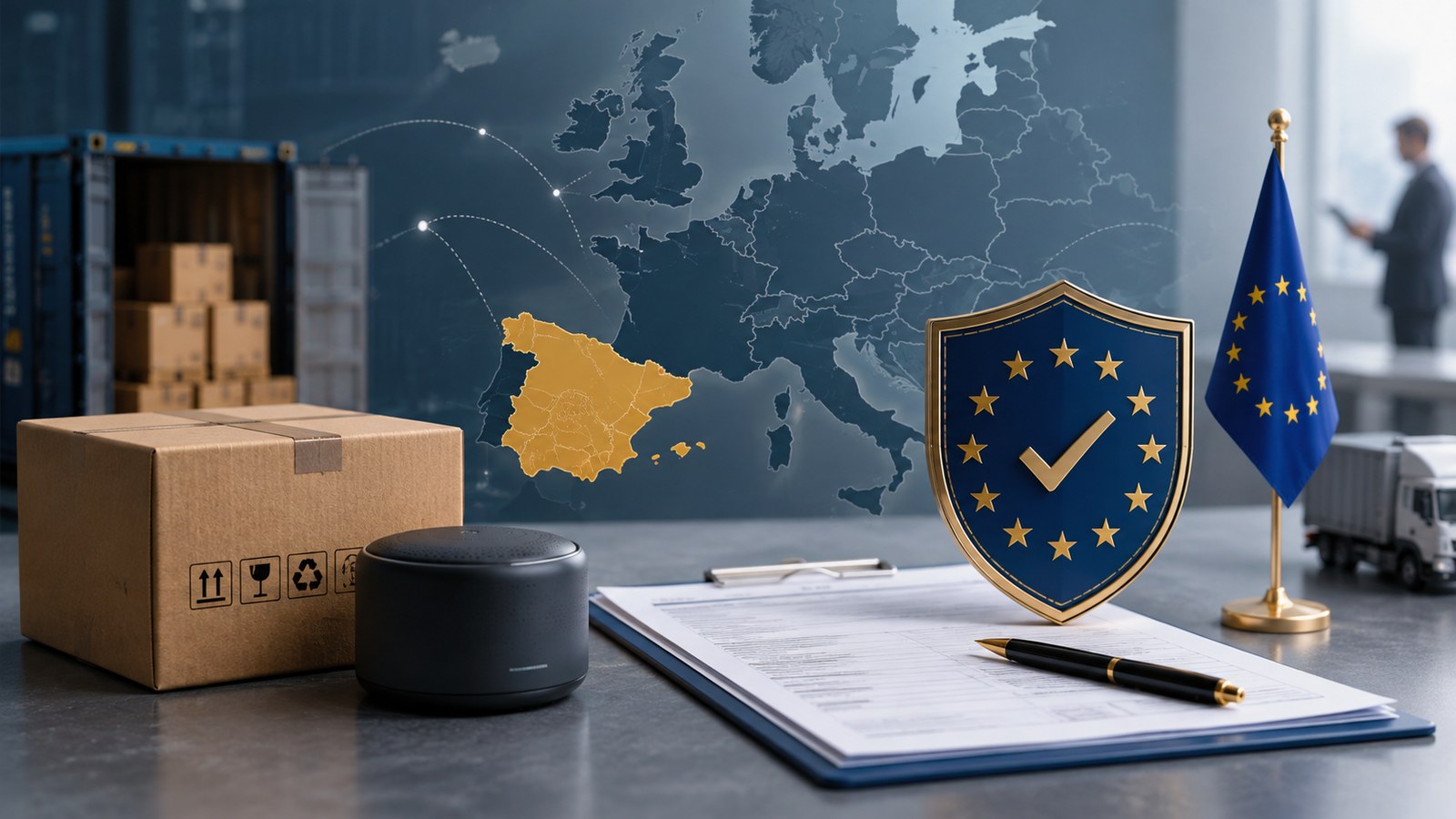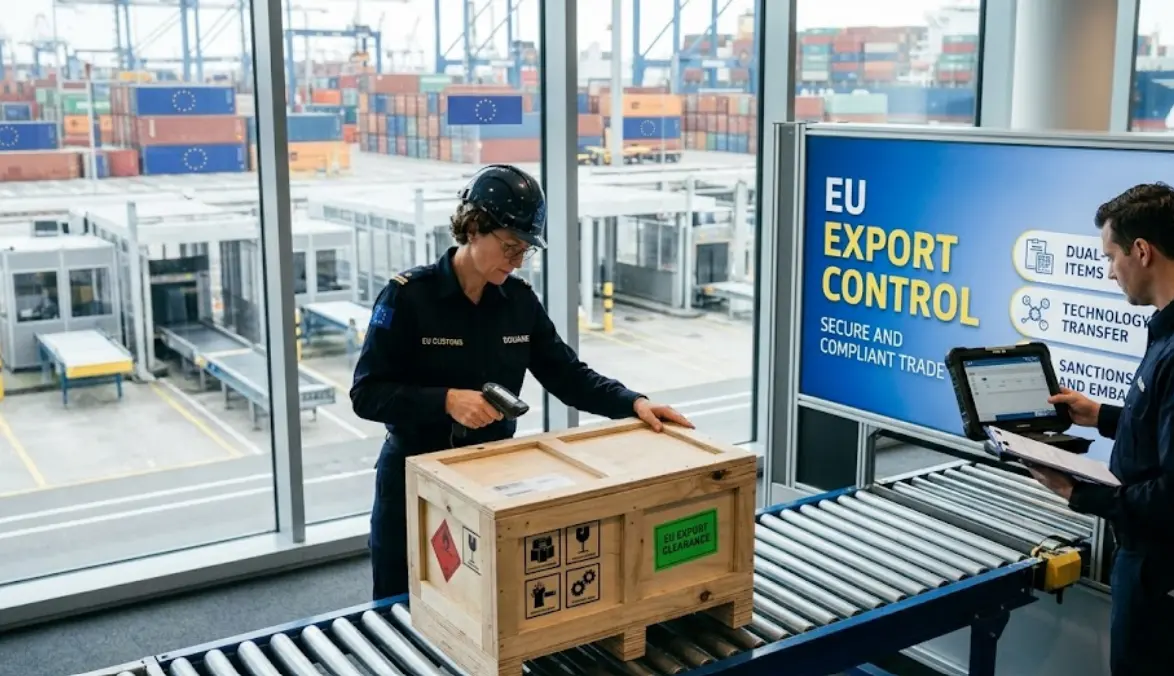

Companies that trade with, manufacture in, or supply into the EU face two overlapping regimes: EU economic sanctions and restrictive measures, and the EU dual-use export control framework under Regulation (EU) 2021/821. This article looks at the ownership and control test, licensing routes, the Blocking Statute and the enforcement reality for non-EU companies — and how we work with Chinese clients at the intersection of these regimes.
Two regimes, one compliance architecture
The Legal Rule
EU sanctions and dual-use export controls for non-EU companies: Regulation (EU) 2021/821, the 50% ownership rule, licensing routes, Blocking Statute and enforcement.
The Business Impact
Verify classification, customs value, origin, licence status and the document chain for the actual goods. A mistake in any one of those inputs can delay clearance or change the duty, preference or penalty exposure. Apply that to the facts of EU Sanctions and Dual-Use Export Controls: Regulation (EU) 2021/821, the 50% Rule and Compliance for Non-EU Companies.
The EU applies economic sanctions and restrictive measures through Council decisions and regulations addressed to specific countries, sectors and designated persons, and separately controls dual-use items under the EU Dual-Use Regulation (Regulation (EU) 2021/821), whose Annex I control list covers electronics, software, encryption tools, chemicals and emerging technologies. For a non-EU company the two regimes interact: exports into the EU, EU-origin content in products, technology transfers and payments routed through EU financial institutions can each bring the company inside EU jurisdiction. A compliance architecture that treats the two regimes separately is usually a mistake; the screening data, end-user questions and licence records overlap.
The sanctions regime operates through country-specific and thematic measures — asset freezes, travel bans, export and import restrictions, and financial prohibitions — set out in Council regulations that are directly applicable in the member states. The dual-use regime operates through the control list and the licensing obligation: an exporter must obtain a licence from the competent national authority (in Germany, BAFA; in the Netherlands, the Ministry of Foreign Affairs; in France, the Directorate General of the Treasury) before exporting listed items to destinations where the item is controlled. For a Chinese company, the interaction is usually felt in the supply chain: EU-origin components, software, or technology embedded in a Chinese product can pull the Chinese exporter into the EU licensing or re-export analysis, and an EU customer's sanctions screening can reach into the Chinese supplier's ownership structure.
The 50% rule and control tests
EU asset-freeze measures apply not only to listed persons but, in many regimes, to entities that are owned or controlled by them. The ownership and control analysis is where most compliance programmes go wrong: the "50% rule" asks whether a designated person, individually or jointly, holds 50% or more of the property or beneficial interests of an entity, or exercises control over it. The rule is applied through the EU's best practices on the implementation of restrictive measures, and the analysis requires a multi-layer look-through: a Chinese group whose ultimate shareholder is a listed person, or whose joint venture partner is designated, can find its EU-facing transactions blocked even though the direct counterparty is a clean entity.

- EU Sanctions and Dual-Use Export Controls: Regulation (EU) 2021/821, the 50% Rule and Compliance fo….
- EU CONTROL MAP
- Restrictive measures / sanctions lists
- Asset freezes and sector bans
Control is broader than ownership. Even below the 50% threshold, an entity can be caught where the designated person exercises decisive influence — through board control, veto rights, management appointment, or funding dependence. The compliance architecture therefore needs an ultimate beneficial ownership (UBO) screen that climbs the ownership chain, plus a control screen that looks beyond shareholding. In our work with Chinese clients, the most common finding is not an outright designation; it is an indirect link — a minority but decisive shareholder, a designated person sitting on the board of the supplier, or a Russian-linked JV partner — that the company's standard counterparty screening never caught because it stopped at the first level.
Licensing routes and the dual-use framework
Where a dual-use export requires a licence, the applicant must deal with the competent national authority of the member state where the exporter is established. The EU licensing framework under Regulation (EU) 2021/821 includes EU General Export Authorisations (GEA) for defined destinations and conditions, national general authorisations, and individual licences for specific transactions. For a Chinese company, the licence analysis has three dimensions: the item's classification (is the hardware, software, or technology on the Annex I control list?), the destination (is the country subject to an embargo, an arms embargo, or a higher-scrutiny regime?), and the end use (is there any indication the item could be used in a weapons programme or a sanctioned activity?).
The catch-all provisions matter for Chinese exporters: even an unlisted item can require a licence where the exporter has been informed by the competent authority, or is aware, that the item is or may be intended for a use connected with weapons of mass destruction or military end use in a country subject to an arms embargo. The exporter's awareness duty means the end-use and end-user questions are not optional; they are the trigger for the licence. The practical file is a classification memo for each controlled or near-controlled item, an end-use questionnaire for each sensitive transaction, and a licence register with the expiry dates and conditions of every authorisation.
The EU Blocking Statute and its limits
The EU Blocking Statute (Council Regulation (EC) No 2271/96) protects EU operators against the extraterritorial application of specified third-country sanctions legislation, including US secondary sanctions in defined cases. The Blocking Statute prohibits EU persons from complying with the listed US measures, unless an authorisation is granted, and it allows EU operators to recover damages caused by their application. For a Chinese company with EU operations, the Blocking Statute creates a compliance tension: a Chinese group that also operates in the EU may face a US sanctions demand on one side and an EU prohibition on compliance on the other, and the resolution is a matter of careful scoping — which measures are listed, which activities are covered, and whether an authorisation from the Commission is available.
The Blocking Statute is frequently misunderstood as a shield for any sanctions exposure. It is not a general licence to trade with sanctioned parties; it operates only within its defined scope, and its prohibitions apply to EU persons. A Chinese company that treats the Blocking Statute as a reason to continue trading with a sanctioned counterparty through its EU entity is misreading the regulation and building a real exposure. The correct analysis is a structured conflict-of-laws assessment: identify the specific US measure, the EU compliance obligation, the entity through which the transaction flows, and the authorisation route.
Enforcement reality and appeals
EU member states enforce sanctions and export controls through national authorities, and the enforcement record is active: fines, licence revocations, and criminal referrals for deliberate violations, alongside administrative measures for negligent failures. The enforcement reality for non-EU companies is that the EU authorities investigate through the entities that touch the EU — the EU subsidiary, the EU importer, the bank processing the payment — and the evidence trail runs through corporate records, emails, and transaction data. A Chinese company whose EU-facing trade has a compliance gap can be reached through its EU counterparty's file even where the company itself has no EU presence.
The appeal route is important context: the CJEU has addressed the scope of EU restrictive measures, including the Rosneft case (C-72/15) on the application of EU sanctions to non-EU entities and the preliminary-ruling mechanism for sanctions questions. The case law confirms that the EU's restrictive measures are applied to conduct with a sufficient link to the EU, and that the listed-person analysis turns on the ownership and control tests discussed above. The practical lesson for Chinese clients is that sanctions compliance is not a static checklist; the designation lists, the case law, and the guidance change continuously, and the compliance programme must be reviewed on a defined cadence.
The compliance architecture: screening data, records, and the audit trail

- Classify items
- Dual-use list / catch-all
- Screen counterparties
- Lists + ownership
- Assess end-use
A layered sanctions and dual-use compliance programme rests on three foundations. First, the screening data: the UBO register, the sanctions list integration, and the transaction-screening protocol that checks counterparties, banks, and ultimate owners against the EU, US, UN, and China lists. The screening must run at counterparty onboarding and at every transaction, because designation lists change monthly and a counterparty that was clean at onboarding can be designated before the next order. Second, the records: the classification memos, the licence register, the end-use questionnaires, and the shipment records that tie each export to its authorisation. Third, the audit trail: the internal reviews, the training records, and the escalation logs that show the programme is operated, not merely documented.
The audit trail is what distinguishes a compliance programme from a compliance costume. When an EU authority investigates, it asks not only whether the company had procedures but whether it followed them: who ran the screen, on which date, for which transaction, and what the result was. A Chinese company whose programme produces a searchable audit trail can answer those questions in days; a company whose procedures exist only as a PDF responds with explanations, and explanations are what investigations are built on. The investment in the audit trail — the dated logs, the named owners, the retained records — is the investment that converts a compliance programme into a defence.
What we see in the field: working with Chinese clients on EU sanctions and dual-use
In our work with Chinese manufacturers, traders, and investment groups on EU sanctions and export-control exposure, the engagements usually start with one of three triggers: an EU customer refuses to contract because of a screening flag; a payment is blocked at an EU bank; or a joint-venture partner's designation threatens the group's EU trade. The pattern across all three is the same: the company's screening stopped at the direct counterparty, and the ownership and control link — the minority shareholder, the board seat, the Russian-linked partner, the EU-origin component embedded in the product — was never mapped. The fix we build with Chinese clients is a layered compliance architecture: a UBO and control register that climbs the ownership chain, an item classification memo for the products that touch EU controls, an end-use questionnaire protocol for sensitive transactions, and a licence register with renewal dates. The companies that avoid the blocked payment and the refused contract are the ones that run the layered screen before the transaction, not after the bank call. The same architecture that satisfies the EU regime also produces the evidence that US and China export-control reviews expect, so the investment in the file pays across all three jurisdictions.
Next steps
If your group trades with, manufactures in, or supplies into the EU — or if a counterparty screening flag has already appeared — run the layered ownership and control analysis and the item classification before the next transaction. Engage counsel who can map the interaction between the sanctions regime, the dual-use framework, and the Blocking Statute for your specific structure.
Discussion
Share experience or questions about this topic. This is a public discussion — not legal advice. Do not post confidential case details.
Have a question after reading? Leave it here, or Ask a Lawyer for a free initial intake.
Comments are moderated. China Legal Portal is a directory and information resource; no attorney–client relationship is formed by posting here.