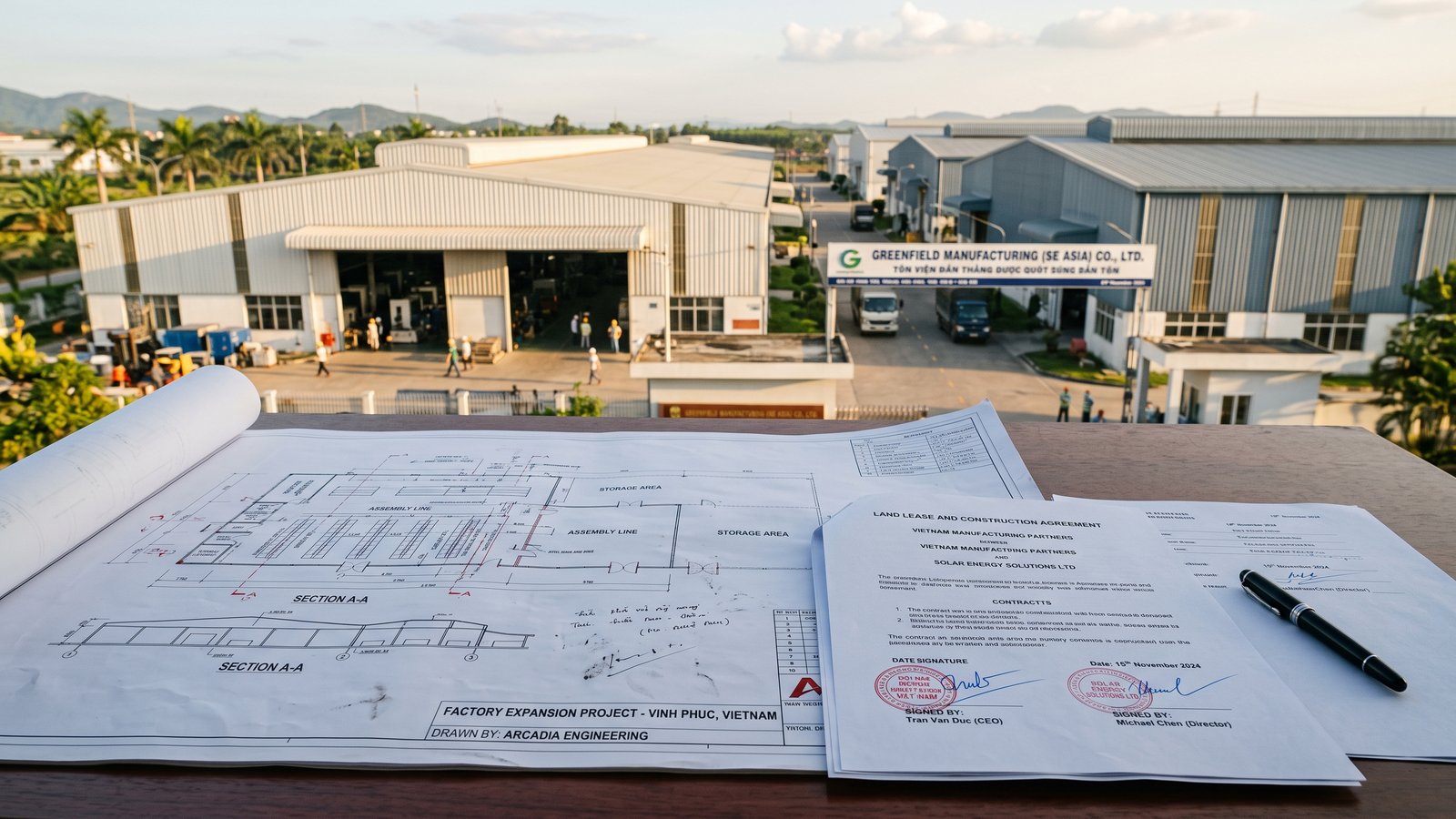

A Chinese manufacturer decides to establish an overseas plant. Management chooses a site, negotiates incentives with the host government, signs a land or factory agreement, orders construction, and plans to ship production lines from China. The commercial team treats the project as an overseas real-estate and corporate exercise. The China legal team treats outbound investment filings as a separate closing checklist. The export-control team is consulted only when machinery is ready to leave the port.
That sequencing can be disastrous.
For a Chinese outbound manufacturing project, the most dangerous legal failures often occur before the first machine is installed. The investment structure may require China-side outbound investment procedures; the financing timetable may depend on those procedures; the equipment list may contain controlled dual-use items or controlled technology; the engineering team may intend to transfer technical data that is itself within an export-control regime; and the project contracts may make the investor liable for delays even where a China export license cannot be obtained.
The specific problem
The Legal Rule
Management chooses a site, negotiates incentives with the host government, signs a land or factory agreement, orders construction, and plans to ship production lines from China.
The Business Impact
Use “Chinese Manufacturers Building Overseas Plants: How China-Side ODI and Export-Control…” to set the compliance steps before the goods move, not after they reach the border. Confirm the declarant, permits, valuation basis and supporting evidence early enough to fix gaps without disrupting delivery.
This article analyzes that narrow issue: how a Chinese manufacturer should integrate outbound-investment compliance and export-control analysis into the transaction structure before signing binding overseas project commitments.
It is not a country-selection guide. It is a transaction-control problem.
1. The first legal map must separate the investment from the exports
China regulates outbound investment and export control through different legal regimes with different regulators, procedures and risk concepts.
The Ministry of Commerce's Measures for the Administration of Overseas Investment define overseas investment to include establishing or acquiring non-financial enterprises abroad or obtaining ownership, control, management rights or other interests through new establishment, merger, acquisition or other methods. The measures use a filing-oriented model for many ordinary investments while reserving approval for specified sensitive circumstances.[1]
Separately, the National Development and Reform Commission's Administrative Measures for Enterprise Overseas Investment regulate overseas investment by domestic enterprises and define investment broadly to include the use of assets, equity, financing or guarantees to acquire overseas ownership, control, management or related interests.[2]
Neither regime answers the export-control question.
The Export Control Law applies to controlled items including dual-use items, military products, nuclear items and other goods, technologies and services related to national security or non-proliferation obligations. Crucially, Article 2 states that controlled items include related technical materials and data, and defines export control to cover transfers from China to abroad as well as provision of controlled items by Chinese persons or entities to foreign organizations or individuals.[3]
That means the project team should create two legal maps on day one:
- Capital and investment map — who is investing, through what vehicle, in what jurisdiction, with what financing and guarantees, and what China outbound-investment procedures apply.
- Item and technology map — what machinery, software, technology, technical data, drawings, source code, samples or services will move from China to the overseas entity or project.
A frequent mistake is to assume that if the overseas investment itself is permitted or filed, the transfer of machinery and technology is automatically lawful. It is not.
2. Signing the land or EPC contract too early can create a regulatory timing trap
Consider a manufacturer that signs a host-country land lease requiring construction to begin within 90 days and production to commence within twelve months. It also signs an EPC contract with delay liquidated damages and enters into a customer supply agreement promising local production by a fixed date.
Only later does the company prepare its equipment export list.
If one critical machine or technology requires an export license, the entire production timetable may become dependent on a regulatory process that was not reflected in the contracts. The result can be contractual default even though the project remains commercially sound.
The Export Control Law establishes a licensing system. Article 12 requires a license for items on the control list or subject to temporary controls. The same article also requires an exporter to apply for a license for an item outside the list where the exporter knows, should know, or has been notified that the item may create specified national-security, WMD or terrorism risks.[3]
The 2024 Regulations on Export Control of Dual-Use Items further operationalize this framework and took effect on December 1, 2024.[4] China also issued a unified Dual-Use Items Export Control List effective on the same date, consolidating controlled items into a unified system.[5] Current licensing work must also be checked against the applicable annual dual-use import/export licensing catalogue; the 2026 catalogue took effect on January 1, 2026.[6]
Therefore, the project timetable should not assume that an item is unrestricted merely because the engineering team has shipped similar equipment in the past.
A better approach is to make the early project schedule conditional on a completed export-control classification and licensing assessment.
3. The equipment list is not enough
A plant relocation or greenfield project usually involves more than physical machinery.
The following may move across the border:
- production equipment;
- testing equipment;
- calibration tools;
- specialized sensors;
- encryption products;
- manufacturing software;
- firmware;
- technical drawings;
- process recipes;
- source code;
- maintenance manuals;
- engineering services;
- remote technical support;
- training materials; and
- proprietary data sets.
Article 2 of the Export Control Law expressly includes technical materials and data related to controlled items.[3] The dual-use regulations likewise define the regime around goods, technologies and services that can have civilian and military use.[4]
This makes the engineering workstream central to legal compliance.
A manufacturer should not ask only, “Is this machine controlled?” It should ask:
- Is any embedded component controlled?
- Is the software separately controlled?
- Does remote access expose controlled technical data?
- Will Chinese engineers provide technical know-how to a foreign entity?
- Will the overseas subsidiary later transfer the equipment or know-how to another country?
- Is the end user the foreign subsidiary, the local joint venture, a contractor, or the ultimate customer?
The legal analysis is only as good as the technical data supplied by engineering. For high-risk equipment, classification should be supported by specifications, model numbers, performance parameters and use cases, not informal product descriptions.
4. “Our own overseas subsidiary” is still a foreign recipient for export-control purposes
Commercial teams often think of a wholly owned foreign subsidiary as “part of the same company.” Corporate law does not erase the cross-border transfer.
The Export Control Law regulates transfers from China abroad and provision by Chinese persons or entities to foreign organizations and persons.[3] A foreign subsidiary is a separate legal entity established outside China. The fact that the Chinese parent owns 100 percent does not make the transfer domestic.
This matters for:
- machinery exports;
- technology licensing;
- remote engineering support;
- source-code access;
- training; and
- later retransfers.
Project contracts should therefore identify the actual legal recipient and end user rather than using vague group-company descriptions.
5. End user and end use must be designed into the project documentation
Article 13 of the Export Control Law states that licensing review may consider national security and interests, international obligations, the type and sensitivity of the item, destination, end user and end use, the exporter's credit record and other legally specified factors.[3]
Article 15 requires submission of end-user and end-use certification documents for controlled items, while Article 16 requires the end user to undertake not to change the end use or transfer the item to a third party without permission from the competent authority. Exporters and importers that discover a possible change of end user or end use must report it as required.[3]
This can collide with ordinary manufacturing-project flexibility.
Suppose the business model contemplates:
- leasing excess equipment to an affiliate;
- transferring a production line to another plant after three years;
- contract manufacturing for third-party customers;
- using one testing platform for several subsidiaries; or
- moving equipment between free-trade zones.
Those possibilities should be identified before the export license application and before the commercial contracts are finalized. Otherwise the local team may later treat a commercially ordinary transfer as an internal asset reallocation without recognizing the export-control implications.
The investment agreement, equipment ownership policy and internal asset-transfer procedures should therefore be consistent with the approved end use.
6. A licensing condition should appear in the project contracts
One of the most practical protections is also one of the most frequently omitted: a regulatory-license condition precedent and delay allocation clause.
If a critical production line requires an export license, the overseas land contract, EPC agreement, equipment supply contract and customer commitments should not assume unconditional delivery.
At minimum, the relevant project documents should address:
- whether regulatory approval is a condition precedent;
- which party is responsible for preparing information;
- whether the investor must use “reasonable efforts” or a higher standard;
- what happens if the regulator requests additional end-user information;
- whether the completion timetable automatically extends;
- whether delay liquidated damages apply;
- whether either party may terminate if a license is denied; and
- what happens to advance payments and partially completed construction.
The clause should not purport to require a party to violate Chinese law. Nor should it promise that a license will be obtained.
A well-drafted project contract treats licensing as a defined risk, not an excuse discovered after default.
7. Temporary controls mean classification is not a one-time exercise
Article 9 of the Export Control Law authorizes temporary controls over items outside the ordinary control list where required for national-security, non-proliferation or related reasons, and Article 10 permits prohibitions on exports of certain controlled items or exports to certain destinations, organizations or individuals.[3]
The dual-use regulations contain corresponding mechanisms for list administration and temporary control.[4]
A project can last several years. Equipment may be ordered in one year, manufactured in another and exported later. The control status that existed when the investment agreement was signed may not be the control status at shipment.
Therefore the company should classify items at least at three points:
- transaction diligence — before binding project commitments;
- procurement release — before equipment is ordered or customized; and
- pre-export check — shortly before shipment.
For a long-running plant project, a change-monitoring process should sit between those stages.
8. The overseas financing model can amplify export-control failure
Manufacturing projects are often financed by a combination of parent equity, shareholder loans, bank debt, host-country incentives and equipment financing.
Suppose a lender conditions drawdown on delivery and installation of equipment. If a critical line cannot be exported, the borrower may fail a financing condition. That can trigger a construction-payment shortfall, which in turn creates contractor claims and threatens government incentives.
The legal team should map financing conditions against regulatory dependencies.
Relevant questions include:
- Does the lender require evidence of China ODI filings or certificates?
- Is financing available before equipment export approval?
- Does the loan agreement contain sanctions or export-control representations broader than Chinese law?
- Can a regulatory delay constitute a material adverse effect?
- Are unused commitments cancellable?
- Is the parent guarantee triggered if production does not start on time?
Outbound investment procedures and export controls should therefore be included in the finance-condition matrix.
9. The NDRC and MOFCOM processes should be tied to transaction milestones
The NDRC's overseas-investment measures and MOFCOM's overseas-investment measures use different regulatory structures and should be reviewed for the proposed investment, including whether a project falls within filing or approval requirements and whether sensitive countries, regions or industries are involved.[1][2]
A practical project plan should identify:
- investment entity;
- ultimate project company;
- project amount;
- sensitive-country or sensitive-industry questions;
- equity, debt and guarantee components;
- intended signing date;
- filing/approval milestones;
- financing drawdown date; and
- closing or capital-injection date.
The commercial team should not sign an agreement that requires an impossible capital transfer timetable.
For example, if the purchase agreement requires a deposit before the investor can complete relevant China procedures, counsel should analyze whether the payment route is legally and operationally workable.
10. The joint-venture structure creates a second export-control layer
If the overseas project is a joint venture, the Chinese party may transfer machinery or technology to an entity partly owned by a foreign partner. That increases the importance of end-user and technology-control terms.
The JV agreement should address:
- who can access controlled technology;
- technical staff access rights;
- information-security controls;
- restrictions on subcontractors;
- restrictions on use for third-party production;
- onward transfer;
- change of control;
- board approval for asset relocation;
- obligations if a license is revoked or modified; and
- return, deletion or destruction of technical materials after exit.
The Chinese investor should avoid a governance structure in which the foreign partner can cause the joint venture to use controlled equipment or technology in a manner inconsistent with the approved end use.
11. Internal compliance can produce licensing benefits, but it must be real
Article 14 of the Export Control Law provides that exporters with an internal export-control compliance system that operates well may receive facilitation measures such as general licenses for certain controlled items, subject to applicable rules.[3]
This makes internal compliance commercially relevant.
A paper policy is not enough. For an overseas plant project, the compliance system should connect:
- product classification;
- customer and end-user screening;
- end-use review;
- engineering release;
- contract review;
- logistics;
- customs declaration;
- license management;
- record retention; and
- escalation.
The plant project's master data should identify controlled items so that a later spare-parts shipment or remote support request does not bypass review.
12. Export-control liability can extend beyond the exporter
The Export Control Law creates significant penalties for unauthorized exports and other violations. Article 34 addresses exports without required authorization, exports beyond the authorized scope and exports of prohibited controlled items. Article 36 also addresses service providers that knowingly provide agency, freight, delivery, customs declaration, e-commerce platform or financial services to an export-control violation.[3]
This matters contractually.
Freight forwarders, brokers, banks and customs agents may ask for export-control representations or supporting documents. If the exporter cannot provide them, shipment may be delayed even before the regulator becomes involved.
The project should therefore create a compliance-document pack for logistics providers.
13. The project data room should contain an export-control sub-file
M&A and greenfield data rooms usually focus on corporate, land, environment, employment, tax and commercial contracts. For an equipment-heavy outbound project, a dedicated export-control folder should exist.
It should include:
- equipment master list;
- technical specifications;
- classification analysis;
- control-list references;
- end-user information;
- end-use description;
- licenses;
- correspondence with authorities;
- supplier export-control representations;
- technology-transfer inventory;
- internal approvals; and
- retransfer restrictions.
This becomes particularly valuable if the project is refinanced, sold or audited.
14. Case study: the battery-component manufacturer
Assume a Chinese battery-component company plans a new plant in Southeast Asia.
It signs:
- a 25-year land lease;
- an EPC contract;
- a government incentive agreement;
- a five-year supply contract with an international customer; and
- a bank financing package.
The plant requires advanced testing equipment and proprietary process-control software from China.
After signing, the export-control team discovers that certain equipment specifications require detailed classification and potentially licensing. The foreign subsidiary also intends to allow a contract manufacturer to use the equipment during ramp-up.
The problem is no longer an export-license problem. It has become:
- a construction delay problem;
- a customer default problem;
- a financing condition problem;
- an incentive-compliance problem; and
- an end-use problem.
The better sequence would have been:
Step 1: classify critical equipment before the land and EPC agreements become unconditional.
Step 2: identify the intended end user and any third-party production use.
Step 3: structure contractual milestones around approval risk.
Step 4: align ODI and funding procedures with the capital schedule.
Step 5: prohibit equipment retransfer without compliance review.
Step 6: create fallback options for alternative equipment or phased commissioning.
This is why export control belongs in transaction design.
15. What the board should require before approving the investment
Before final approval of an overseas manufacturing project, the board or investment committee should receive a written legal matrix answering at least the following:
Investment structure
- Which Chinese entity is the investor?
- Which overseas entity will hold land, assets and employees?
- Is the project subject to filing or approval under NDRC and MOFCOM rules?
- Are any sensitive-country or sensitive-industry issues present?
Funding
- How will capital and debt move?
- What procedures are prerequisites to funding?
- Are any parent guarantees or offshore security arrangements contemplated?
Controlled items
- Which machinery, software, technical data and services will be transferred?
- Has each critical item been classified?
- Are any items on the current dual-use control list or subject to temporary control?
- Are any catch-all risk factors present?
End user and end use
- Who will legally receive each controlled item?
- Will subcontractors or JV partners access it?
- Is onward transfer contemplated?
- Is the commercial operating model consistent with the declared end use?
Contracts
- Do the land, EPC, supply and financing documents allocate licensing delay?
- Is regulatory approval a condition precedent where appropriate?
- Is there a termination route if a critical license cannot be obtained?
Compliance
- Who owns the classification process?
- Who monitors control-list changes?
- Who approves technical-data transfers?
- How are spare parts and remote support controlled after start-up?
16. The core drafting principle: never promise a regulatory outcome
An investor may be commercially pressured to guarantee that equipment will arrive by a fixed date. Counsel should resist language that effectively guarantees a governmental approval.
Better drafting distinguishes between:
- obligations within the investor's control;
- obligations to prepare complete and accurate applications;
- cooperation obligations;
- regulatory decisions outside the party's control; and
- consequences of denial or delay.
This is not about creating an unlimited excuse. It is about allocating a foreseeable legal dependency.
17. The project should have a “regulatory critical path”
Construction projects use critical-path scheduling. Legal compliance should use the same concept.
A regulatory critical path might look like:
- finalize equipment design;
- obtain technical data from vendors;
- conduct export-control classification;
- determine license requirements;
- confirm end user and end use;
- complete ODI procedures;
- finalize finance conditions;
- submit any export-license application;
- release equipment for shipment;
- clear customs;
- install and commission;
- activate post-export controls.
If any critical step is uncertain, the commercial schedule should include contingency.
18. Conclusion
The high-risk legal question in an outbound plant is not simply whether the investor can establish a company abroad. It is whether the company can lawfully move the capital, machinery, technology and services needed to make that company operational on the timetable promised to landlords, governments, lenders and customers.
China's overseas-investment rules and export-control regime operate separately but collide inside the same project. The Export Control Law's licensing, end-user, end-use, temporary-control and compliance provisions mean that technical classification must occur before the business makes irreversible project commitments. The NDRC and MOFCOM outbound-investment frameworks must likewise be tied to the funding and closing schedule.
For a Chinese manufacturer, the practical rule is simple:
Do not sign the overseas project first and classify the exports later.
Build the China regulatory critical path before the transaction becomes binding.
Legal sources
[1] Ministry of Commerce, Measures for the Administration of Overseas Investment (MOFCOM Order No. 3 of 2014), effective October 6, 2014: https://www.mofcom.gov.cn/zcfb/blgg/art/2014/art_1d349047003649b7ba2cd5672c1debed.html
[2] National Development and Reform Commission, Administrative Measures for Enterprise Overseas Investment (NDRC Order No. 11 of 2017), effective March 1, 2018: https://zfxxgk.ndrc.gov.cn/web/iteminfo.jsp?id=18522
[3] Export Control Law of the People's Republic of China, effective December 1, 2020, including Articles 2, 9–18, 34 and 36: https://www.npc.gov.cn/c2/c30834/202010/t20201017_308277.html English NPC version: https://www.npc.gov.cn/englishnpc/c2759/c23934/202112/t20211209_384804.html
[4] State Council Order No. 792, Regulations of the People's Republic of China on Export Control of Dual-Use Items, effective December 1, 2024: https://exportcontrol.mofcom.gov.cn/article/zcfg/gnzcfg/gzjgfxwj/202410/1057.html
[5] MOFCOM, MIIT, GACC and State Cryptography Administration Announcement No. 51 of 2024, PRC Dual-Use Items Export Control List, effective December 1, 2024: https://www.mofcom.gov.cn/zcfb/zc/art/2024/art_461aafbb5e974f47b1c23866643cb71c.html
[6] MOFCOM/GACC, 2026 Catalogue for the Administration of Import and Export Licenses for Dual-Use Items and Technologies, effective January 1, 2026: https://exportcontrol.mofcom.gov.cn/article/hgfw/lywxcx/gzqd/202601/1203.html
This article is general legal information, not legal advice for a particular project.
Discussion
Share experience or questions about this topic. This is a public discussion — not legal advice. Do not post confidential case details.
Have a question after reading? Leave it here, or Ask a Lawyer for a free initial intake.
Comments are moderated. China Legal Portal is a directory and information resource; no attorney–client relationship is formed by posting here.